CHE 318 Lecture 13
Introduction To Mass Transfer Coefficients
2026-02-02
Recap
- Review of part I of mass transfer
- Mindmap in mass transfer part I
- Sample questions from previous exams
Learning outcomes
After this lecture, you will be able to:
- Recall why convective mass transfer coefficients are introduced.
- Describe assumptions used to simplify coefficient-based transport models.
- Identify common forms and units of mass transfer coefficients.
Example Questions (Continued)
Long answer question 2
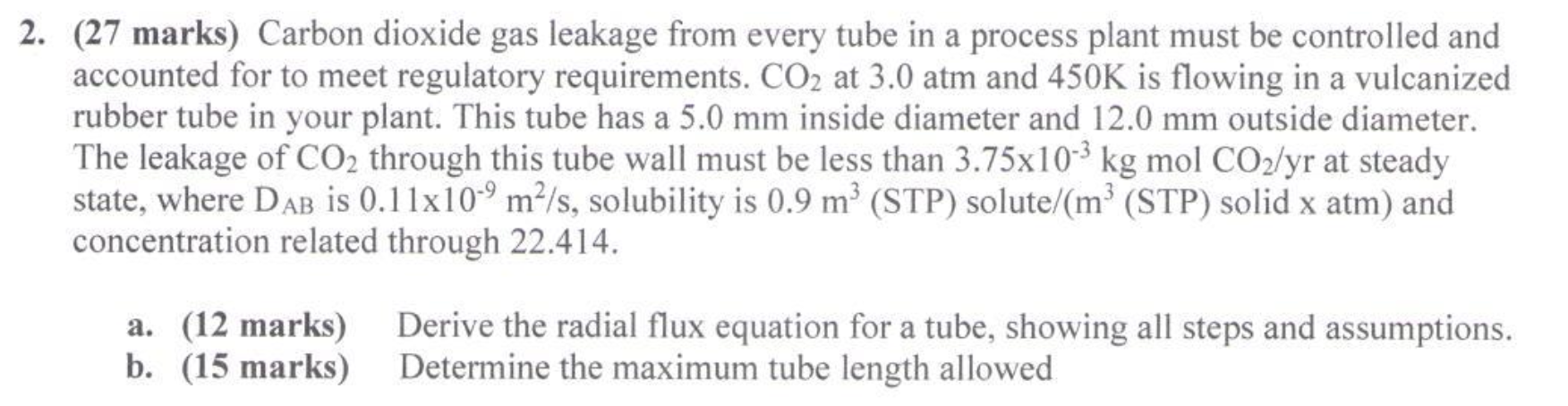
Long answer question 2 – key points
- Diagram (a cylinder with in/out diameter & length)
- Solid diffusion 👉 EMCD-like equation (diffusion only)
- DO NOT write \(N_A \propto 1/(d_2 - d_1)\)!
- Steady state flux eq. in cylindrical coordinate
- Governing eq for cylindrical coordinate
- Use of \(\overline{N}_A\) for steady state
- \(c_A\) from solubility
Long answer question 3
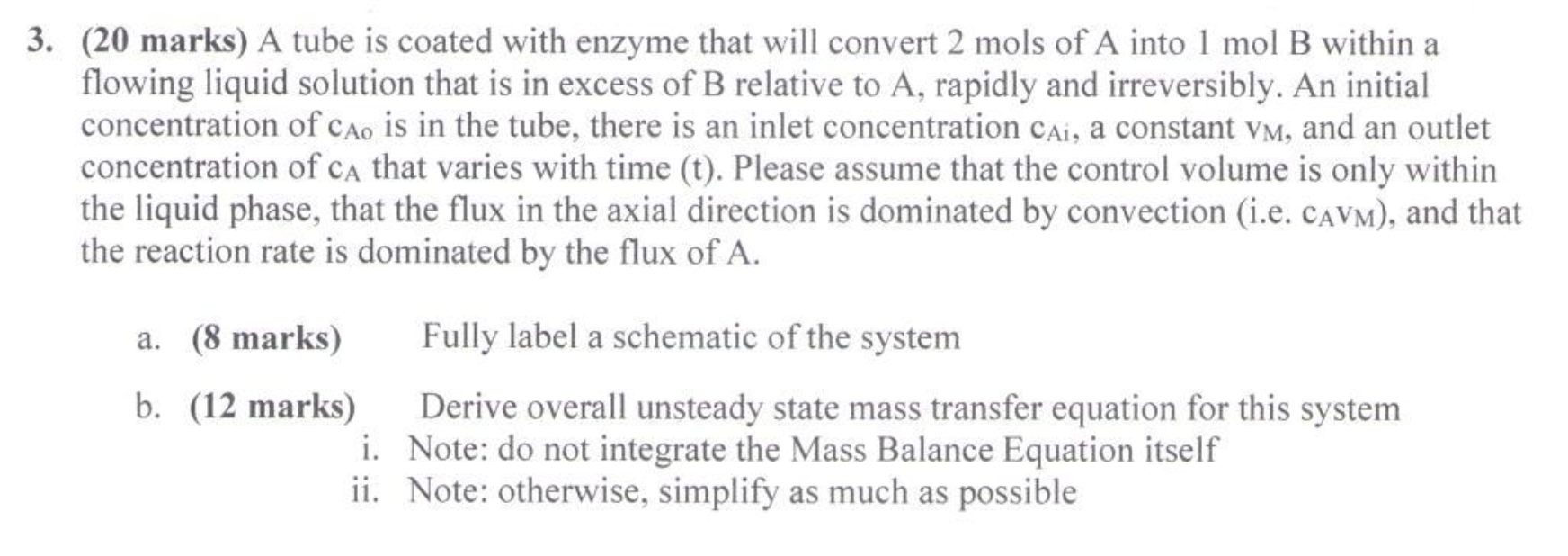
Long answer question 3 – key points
- Diagram (convection in axial / z-axis; diffusion in radial / r-axis)
- Mass balance in control volume
- Generation term link to flux-controlled consumption
- Flux boundary conditions in r-axis
Convective Mass Transfer
Remaining questions from unsteady state mass transfer
Our current knowledge cannot answer questions like this:
- If chemical species A is transferred between two different phases, what is the concentration in each phase?
- How do we solve the mass transfer when \(c\) is not uniform? (See long answer question 2)
- What if fluid becomes turbulent?
What we want to solve in part II: a real engineering problem
You work in a pipeline maintenance team in Enbridge and need to remove a sticky, unwanted coating from the inner wall of a pipeline. There are a few design questions:
- Which flushing liquid works best?
- solvent / water mixture
- solubility of the coating
- How fast should the fluid flow?
- required mean velocity \(v_m\)
- What concentration remains in the liquid?
- outlet concentration of the contaminant
- How fast is the coating removed?
- removal rate vs. \(v_m\)
What you want to report:
- Total volume of flushing liquid required
- Total flushing time to reach acceptable cleanliness
Mass transfer between phases: unsteady state analysis
We will first look at the first problem, \(c_A\) between phase boundaries. This is something we in theory can solve using U.S.S. But what are the boundary conditions?
Question: a polymer membrane of thickness \(2Δ\) contains a chemical with uniform concentration \(c_0\) initially. At \(t=0\), it is suddenly submerged into a solution containing the same chemical with concentration \(c_1\). The volume of liquid is so large that the concentration remains \(c_1\) far away from the membrane-liquid interface. Model the concentration profile \(c(z)\) inside the membrane, and calculate the total chemical absorption rate.
Solving the polymer membrane mass transfer problem
Use the standard procedure for the polymer phase, ignore convection inside
\[ D_{AB} \frac{\partial^2 c_A}{\partial z^2} = \frac{\partial c_A}{\partial t} \]
Initial conditions:
- Inside polymer \(c_A(z, t=0) = c_0\)
- Outside polymer \(c_A(z, t=0) = c_1\)
Boundary conditions?
- How do we know \(c_A(z)\) at the interface?
- They can actually take any value!
Summary
- This lecture bridged the midterm review with the transition to convective mass transfer.
- Boundary problems motivate the need for equilibrium distribution coefficients and mass transfer coefficients.
- Mass transfer coefficients provide a practical way to express convective transport.
What to learn next
- We will introduce the mass transfer coefficient \(k\) as a general parameter for convective mass transfer
- How to use mass transfer coefficients for different phases (gas, liquid, solid)
- How convective fluid transport is expressed using coefficients
- How to perform mass transfer analysis based on transfer coefficients