CHE 318 Lecture 20
Case Studies With Mass Transfer Coefficient (II)
2026-02-27
Learning outcomes
After this lecture, you will be able to:
- Recall characteristic features of convective mass transfer over flat plates, spheres, and packed beds.
- Identify suitable empirical correlations for each geometry and flow regime.
- Apply equations to calculate \(k_c'\), concentration changes, and fluxes in representative case studies.
Cheatsheet for mass transfer coefficient
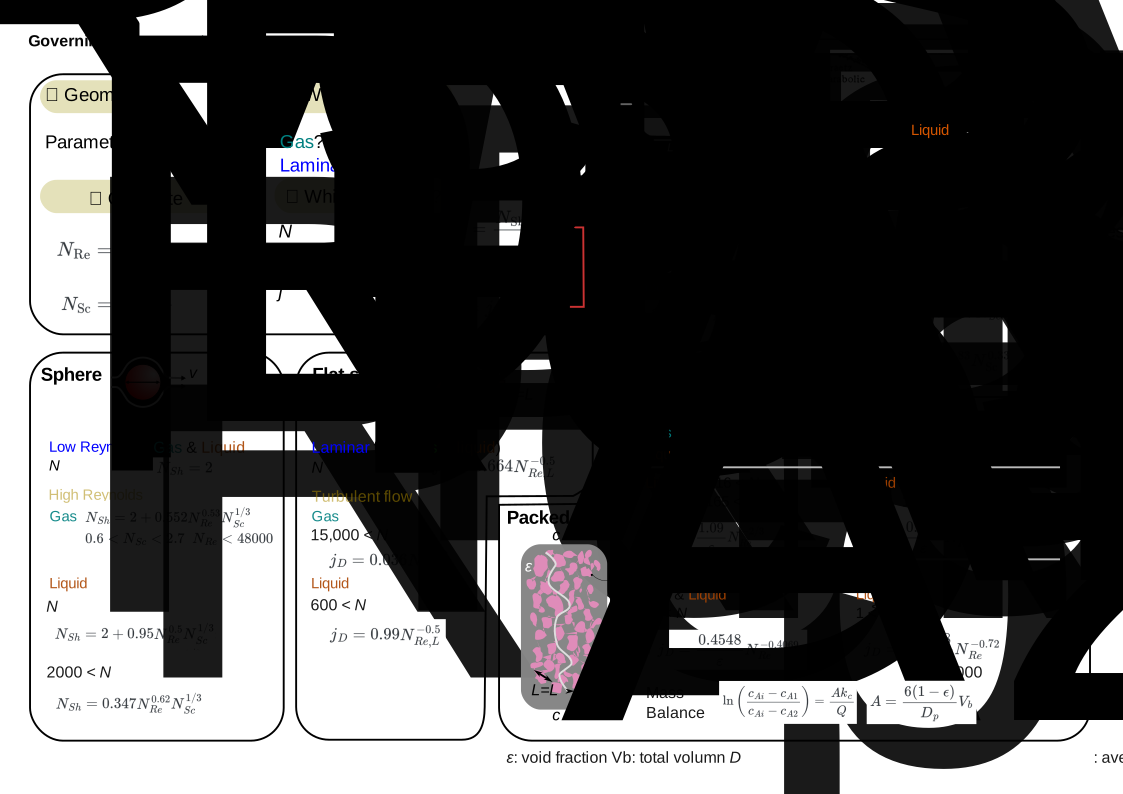
Cheatsheet for using dimensionless numbers with \(k_c'\). Printed version distributed in class
Case 2: flow parallel to flat plates
- Can be used for gases or evaporation of liquid
- Distinguished between laminar & turbulent flow
- \(N_{Re}\) regime cutoff different in gas & liquid!
- Characteristic length \(L\): length of plate in flow direction
- Flow parallel to flat plate: video
Flow past parallel plates: regimes
Laminar flow (\(N_{Re} < 15,000\))
\[\begin{align} j_D &= 0.664 N_{Re, L}^{-0.5} \\ \frac{k_c' L}{D_{AB}} &= 0.664 N_{Re, L}^{0.5} N_{Sc}^{1/3} \end{align}\]- This follows our derivation of boundary layer theory
Turbulent flow
- Gas: \(15,000 < N_{Re}< 300,000\)
- Liquid: \(600 < N_{Re}< 50,000\)
Example for flat plate
Example 7.3-2: A large volume of pure water at 26.1 \(^\circ\)C is flowing parallel to a flat plate of solid benzoic acid, where \(L=0.244\) m in the direction of flow. The water velocity is 0.061 m/s. The solubility of benzoic acid in water is 0.02948 kg mol/m\(^3\), and the diffusivity of benzoic acid in water is \(1.245 \times 10^{-9}\) m\(^2\)/s. For water, \(\mu=8.71\times 10^-4\) Pa\(\cdot\)s and \(\rho=996\) kg/m\(^3\) (basically the same conditions as in case 1-2).
Calculate the mass-transfer coefficient \(k_c\) and \(N_A\).
Flat surface: solution steps
- Step 1: calculate \(N_{Re}\), \(N_{Sc}\). Regime?
- Step 2: use flat-surface equations to calculate \(j_D\)
- Step 3: convert \(j_D\) to \(k_c'\). Use \(k_c = k_c'/x_{BM}\)
- Step 4: use master equation to get \(N_A\)
Flat surface example: results
Tip
We can use \(x_{BM}=1\) in this case
- \(N_{\text{Re}}=1.700\times10^4\), \(N_{\text{Sc}}=702\)
- Use liquid turbulent flow: \(j_D = 0.99 N_{\text{Re}}^{-0.5}\) = 0.00758
- \(k_c' = j_D v N_{\text{Sc}}^{-2/3} = 5.85\times 10^{-6}\) m/s
- \(N_A = 1.726 \times 10^{-7}\) kg mol/m\(^2\)/s
Case 3: flow past single sphere
- Frequent geometry in particle solutions
- Low Reynolds regime 👉 solution for stagnant diffusion on spherical surface
- High Reynolds regime 👉 correct \(N_{Sh}\) and back calculate \(k_c'\)
Flow past single sphere: results
Low Reynolds (\(N_{Re} < 2\))
\[\begin{align} N_A &= \boxed{\frac{2 D_{AB}}{D_p}} (c_{A1} - c_{A2}) \\ &= k_c (c_{A1} - c_{A2}) \\ &= \frac{k_c'}{x_{Bm}}(c_{A1} - c_{A2}) \\ \end{align}\]- For \(x_{Bm} \approx 1\), we have:
\[ k_c' = \frac{2D_{AB}}{D_p} \]
- Sherwood number: \(N_{Sh} = 2\)
High Reynolds (\(N_{Re} > 2\))
- Gas:
- Liquid:
- Back calculate \(k_c' = N_{Sh} \frac{D_{AB}}{D_p}\)
Case 4: mass transfer for packed beds
- Video for fluidized packed bed
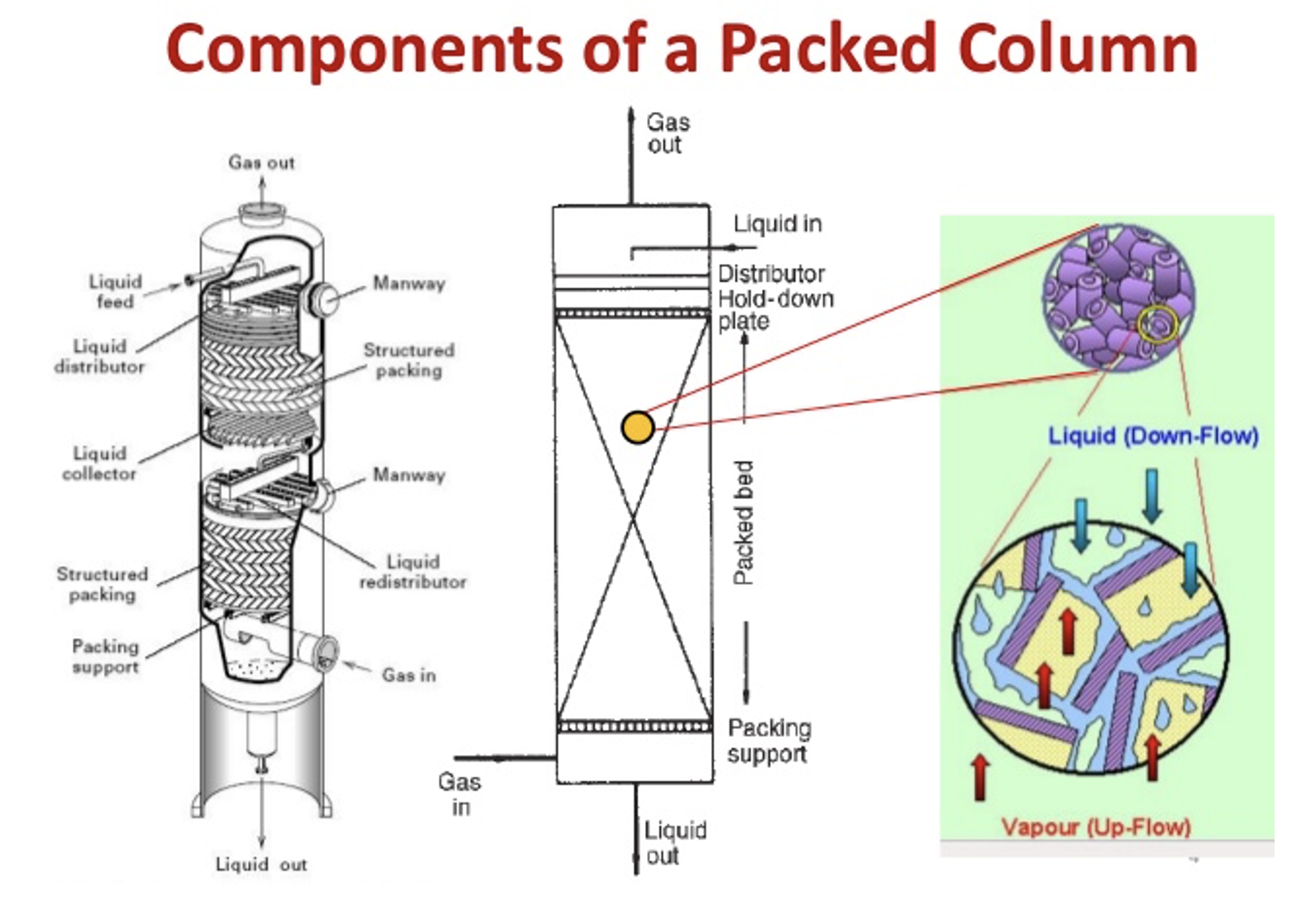
Packed bed structure
Packed bed: geometries
Geometry characteristics: void fraction \(\varepsilon\):
\[ \varepsilon = \frac{\text{void space}}{\text{total space}} = \frac{\text{void space}}{\text{void space} + \text{solid space}} \]
- Typically \(0.3 < \varepsilon < 0.5\)
- Void fraction is difficult to measure experimentally
Total Effective Area for spherical particles:
\[ A = \frac{6(1 - \epsilon)}{D_p} V_b \]
Correlation equations in packed bed
Correlation 1, applicable to:
- gase with \(10 < N_{Re} <10,000\)
- liquid with \(10 < N_{Re} < 1500\)
- \(D_p\): (average) particle diameter
- \(v’\): superficial velocity in the tube without packing
Correlation equations in packed bed (II)
Correlation 2, applicable to:
- liquid with \(0.0016 < N_{Re} < 55\), \(165 < N_{Sc} < 70000\)
- liquid with \(55 < N_{Re} < 1500\), \(165 < N_{Sc} < 10690\)
Correlation equations in packed bed (III)
Correlation 3, applicable to fluidized beds
- \(10 < N_{Re} < 4000\) (gas & liquid)
- \(1 < N_{Re} < 10\) (liquid only)
Example 3: comparison between geometries
Adapted from Problem 7.3-3. Let’s estimate the gas-phase mass transfer coefficient \(k_G\) (kg mol/(m\(^2\) s Pa)) for mass transfer of water vapour to solids with different shapes. Consider a water vapour (A) in air (B) at 338.6 K and 101.32 Pa flowing through a big duct containing solids with various geometries. The flow velocity is 3.66 m/s. The water vapour concentration is small, so property of air is used (\(\mu=2.03\times 10^-5\) Pa\(\cdot\)s, \(\rho=1.043\) kg/m\(^3\)). From the table, \(D_{AB} = 2.88 \times 10^{-5}\) m\(^2\)/s at 315 K. Compare the values for following geometries, which case?
- Flow parallel to flat plate with length \(L=2.54\) cm
- A single sphere with diameter \(D=2.54\) cm
- Packed beds using spheres of average diameter \(D_p=2.54\) cm and \(\epsilon=0.35\)
Example 3: results
Tip
- Do not forget to correct \(D_{AB}\) for temperature!
- Choose the right \(N_{\text{Sh}}\) or \(j_D\) formula according to \(N_{\text{Re}}\) and \(N_{\text{Sc}}\)
- \(k_G \approx k_G' = k_c' / (RT)\)
- Flat surface: \(k_G = 1.738\times 10^{-8}\) kg mol/(m\(^2\) s Pa). \(N_{\text{Sh}} = 38.03\)
- Single sphere: \(k_G = 1.984\times 10^{-8}\) kg mol/(m\(^2\) s Pa). \(N_{\text{Sh}} = 43.40\)
- Packed bed: \(k_G = 7.60\times 10^{-8}\) kg mol/(m\(^2\) s Pa). \(N_{\text{Sh}} = 166.32\)
Packed bed clearly wins!
Summary
- Dimensionless numbers can be used to correlate mass transfer problems in different flow rate, dimension etc
- Typically, start with a known geometry (pipe? parallel plate? sphere? packed bed?)
- Find the correlation with dimensionless numbers \(N_{Re}\), \(N_{Sc}\)
- Calculate the final mass transfer rate
- Geometry plays an important role in determining \(k_c'\)!