CHE 318 Lecture 26
Designing Packed Beds For Concentrated Systems
2026-03-13
Learning outcomes
After this lecture, you will be able to:
- Recall the general procedure for designing a packed tower in concentrated systems.
- Describe the concepts of transfer unit and number of transfer units in packed-bed design.
- Apply realistic concentration profiles to estimate tower height.
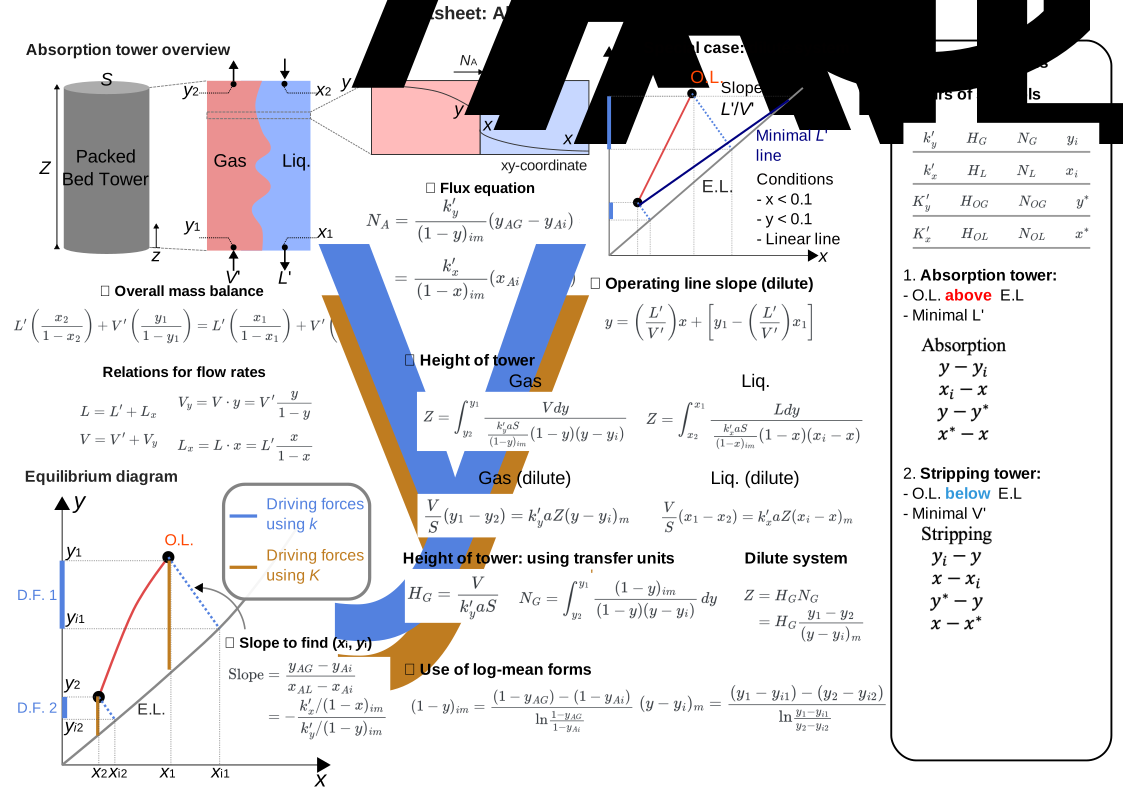
Cheatsheet for packed bed design
![]()
Physical copies distributed in class
Recall: packed tower height equation (individual phase)
General equation for gas. What the meanings for each term?
\[\begin{align}
Z
&=
\int_{y_2}^{y_1}
\frac{V'}{k_y'aS}
\cdot
\frac{(1-y)_{im}}{(1-y)^2(y-y_{i})}
\, dy \\
&= \int_{y_2}^{y_1}
\frac{V}{k_y'aS}
\cdot
\frac{(1-y)_{im}}{(1-y)(y-y_{i})}
\, dy
\end{align}\]
Recall: height equation for diluted system
If \(x<0.1\) and \(y<0.1\), typically use (for gas phase):
\[
Z = \left[ \frac{V}{k'_y a S} \frac{(1 - y)_{im}}{1 - y} \right] \int_{y_2}^{y_1} \frac{dy}{y - y_i}
\]
or even simpler
\[
Z = \left[ \frac{V}{k'_y a S} \right] \int_{y_2}^{y_1} \frac{dy}{y - y_i}
\]
what insights can we get?
Motivation: transfer units for packed beds
From unit analysis, the term \(\frac{V}{k'_y a S}\) characterizes the height. We often use the concept of transfer unit to determine the performance of mass transfer in each phase. For gas phase, we have the “height” of the transfer unit \(H_G\) as
\[\begin{align}
H_G = \frac{V}{k_y' a S}
\end{align}\]
- \(H_G\) is controlled by ratio of flow rate and mass transfer in gas phase
- smaller \(H_G\) means more efficient packing (thus needing shorter tower)
Define the number of transfer units
The rest of the equation for \(Z\) can be rewritten as “number of transfer units”, similar to the theoretical number of trays in a tray tower. For gas phase general case, we have
\[\begin{align}
N_G
=
\int_{y_2}^{y_1}
\frac{(1-y)_{im}}{(1-y)(y-y_i)}
\,dy
\end{align}\]
For dilute system, we can approximate \(N_G\) by
\[\begin{align}
N_G &= \int_{y_2}^{y_1}
\frac{dy}{y-y_i} \\
&= \frac{y_1 - y_2}{(y - y_i)_m}
\end{align}\]
Transfer unit view of packed bed
For dilute system, we can see that
\[\begin{align}
Z &= H_G N_G \\
&= H_G \frac{y_1 - y_2}{(y - y_i)_m}
\end{align}\]
- Total height \(Z\) is a stack of “transfer units” with height \(H_G\)
- Number of the units is governed by the total absorption \((y_1 - y_2)\) and driving force \((y - y_i)_m\)
- Need to absorb more (larger \((y_1 - y_2)\))? 👉 higher tower
- Operation line close to equilibrium? 👉 higher tower
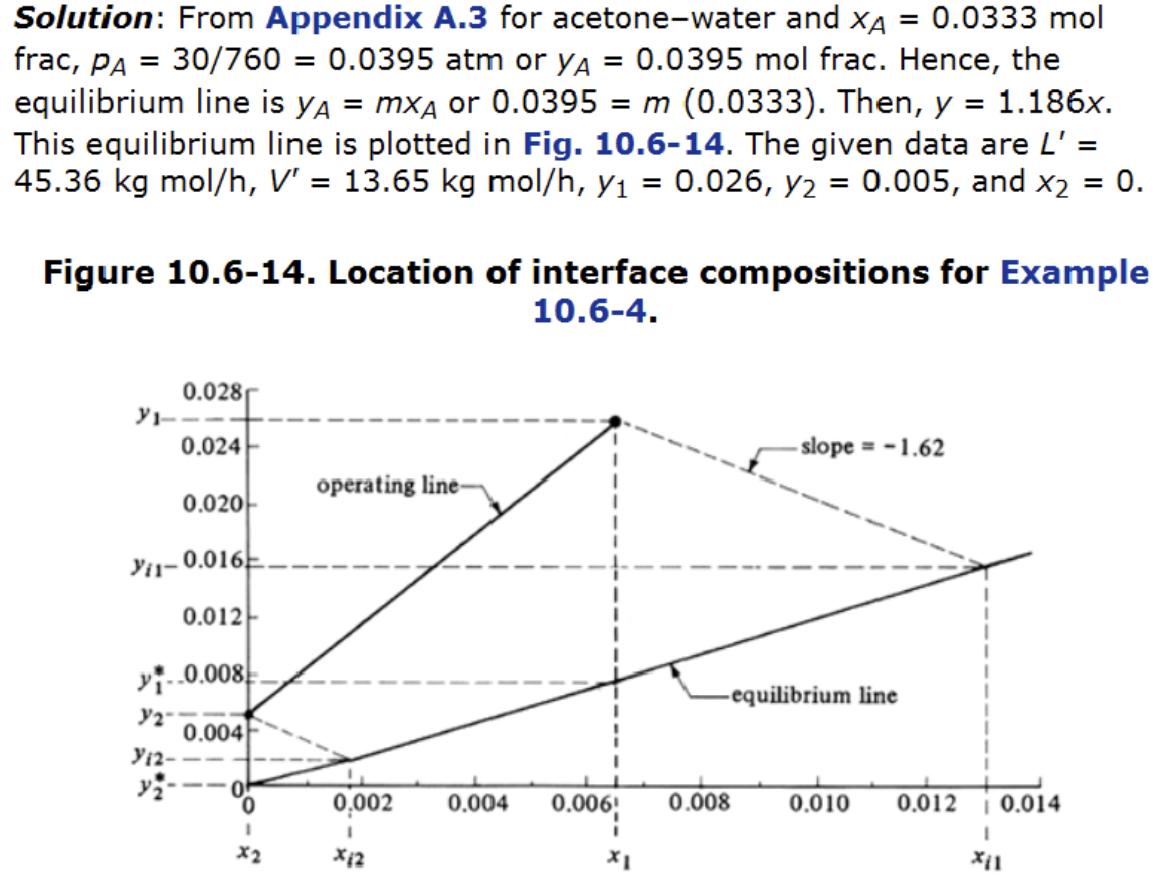
Example 1 diagram
![]()
Practical estimation of \(k_y’ a\) or \(H_G\)
In real packed beds, coefficients are often obtained from correlations (using dimensionless numbers etc), which may depend on:
- \(N_{Re}\), \(N_{Sc}\)
- Weight flow rates \(G_y\), \(G_x\)
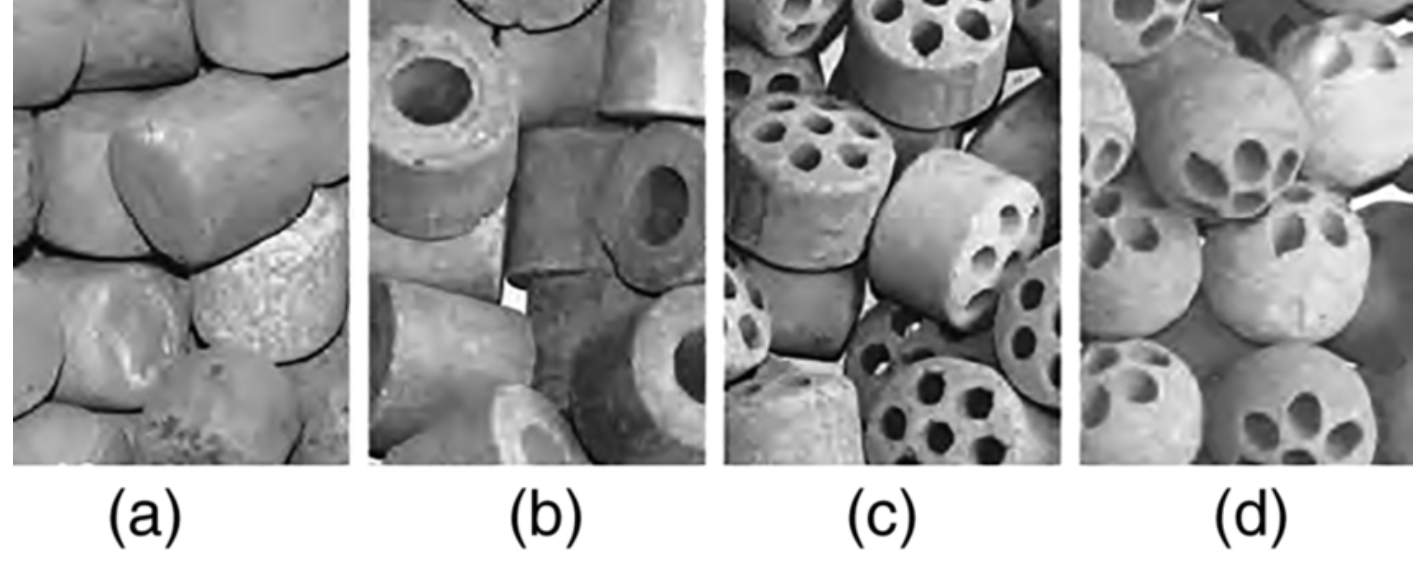
- Packing type (shape? diameter?)
![]()
Example 2: concentrated packed bed design
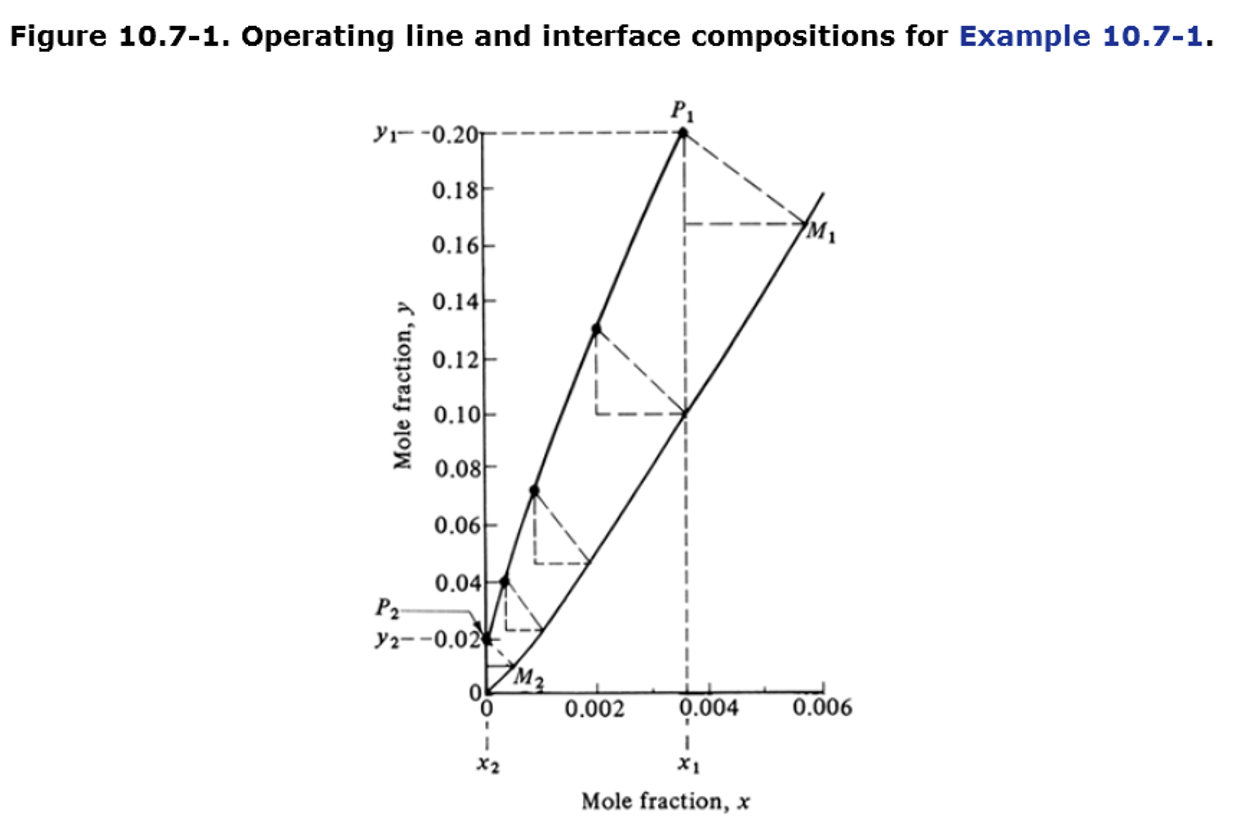
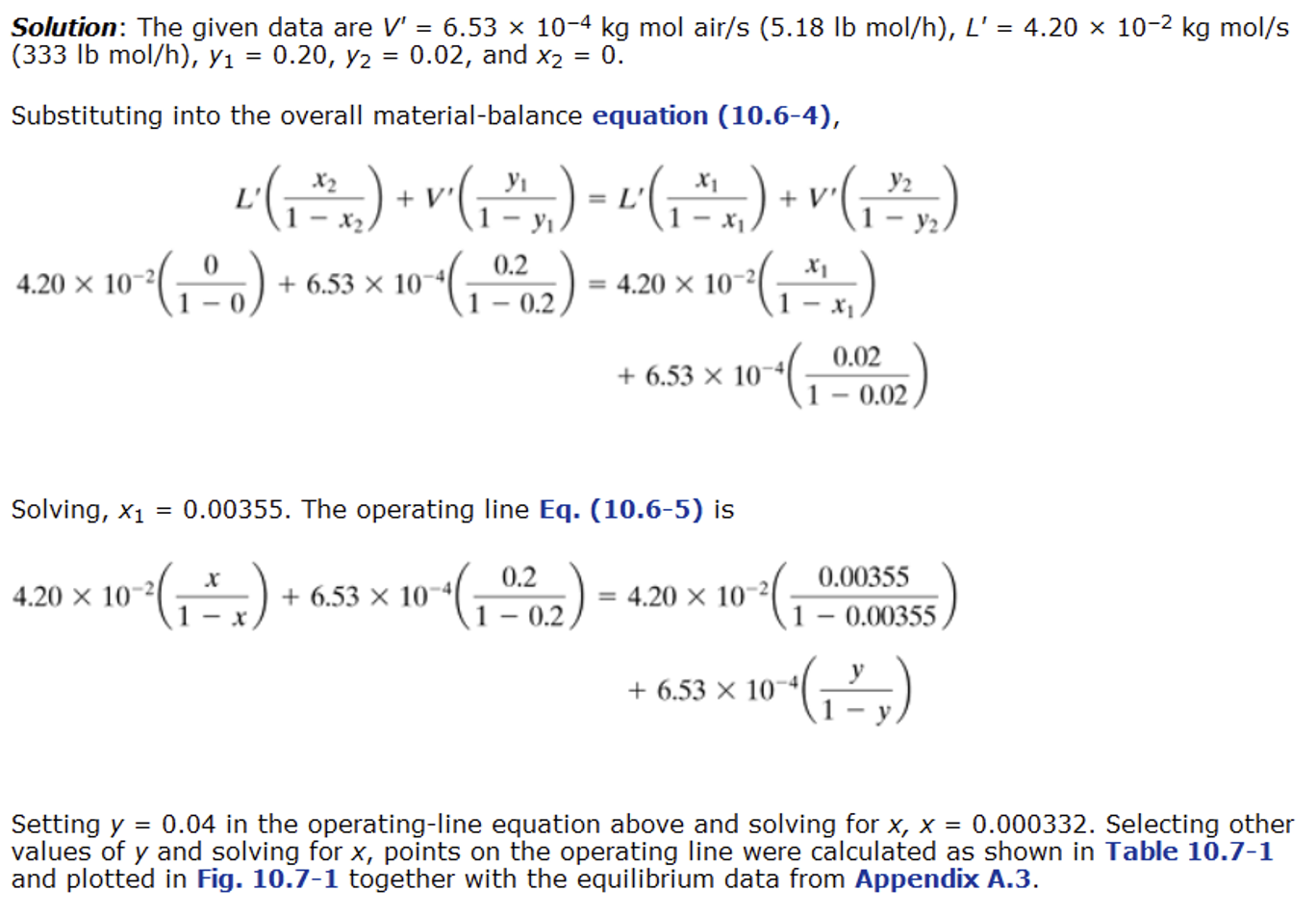
(Example 10.7-1) A tower packed with 25.3 mm ceramic rings is used to absorb SO\(_2\) from air using pure water at 293 K and 1 atm. The entering gas contains 20 mol% SO\(_2\) and leaving gas has 2 mol%. The inert air flow is \(6.53\times10^{-4}\) kg mol/s and inlet water flow is \(4.20\times10^{-2}\) kg mol/s. Cross sectional area of the tower is 0.0929 m\(^2\). From literature, the film mass transfer coefficients are estimated as
\[
k_y' a = 0.0594 G_y^{0.7} G_x^{0.25} \qquad k_x' a = 0.152 G_x^{0.82}
\]
where \(G_x\) and \(G_y\) are total weight of liquid / gas flow per second per area, respectively. Estimate the tower height needed.
Notes on the integration
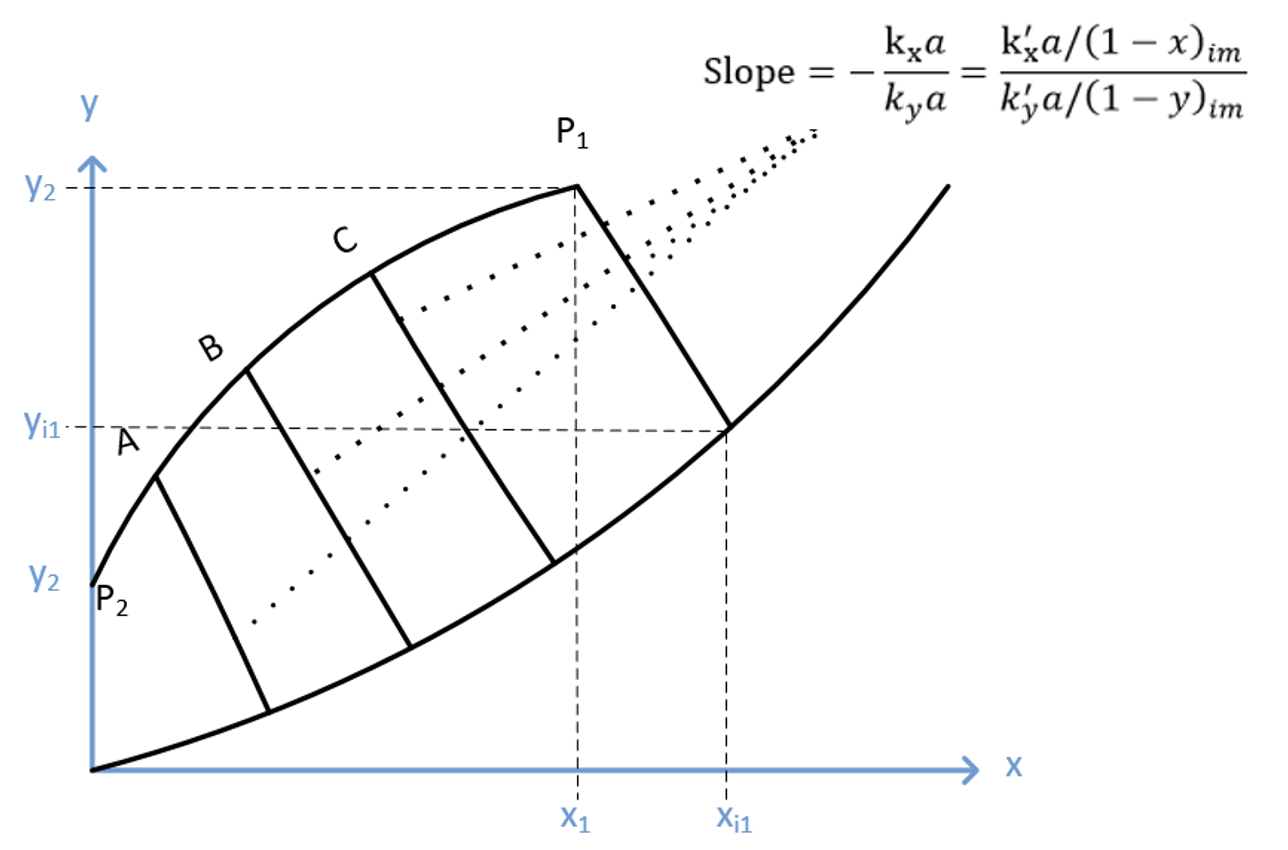
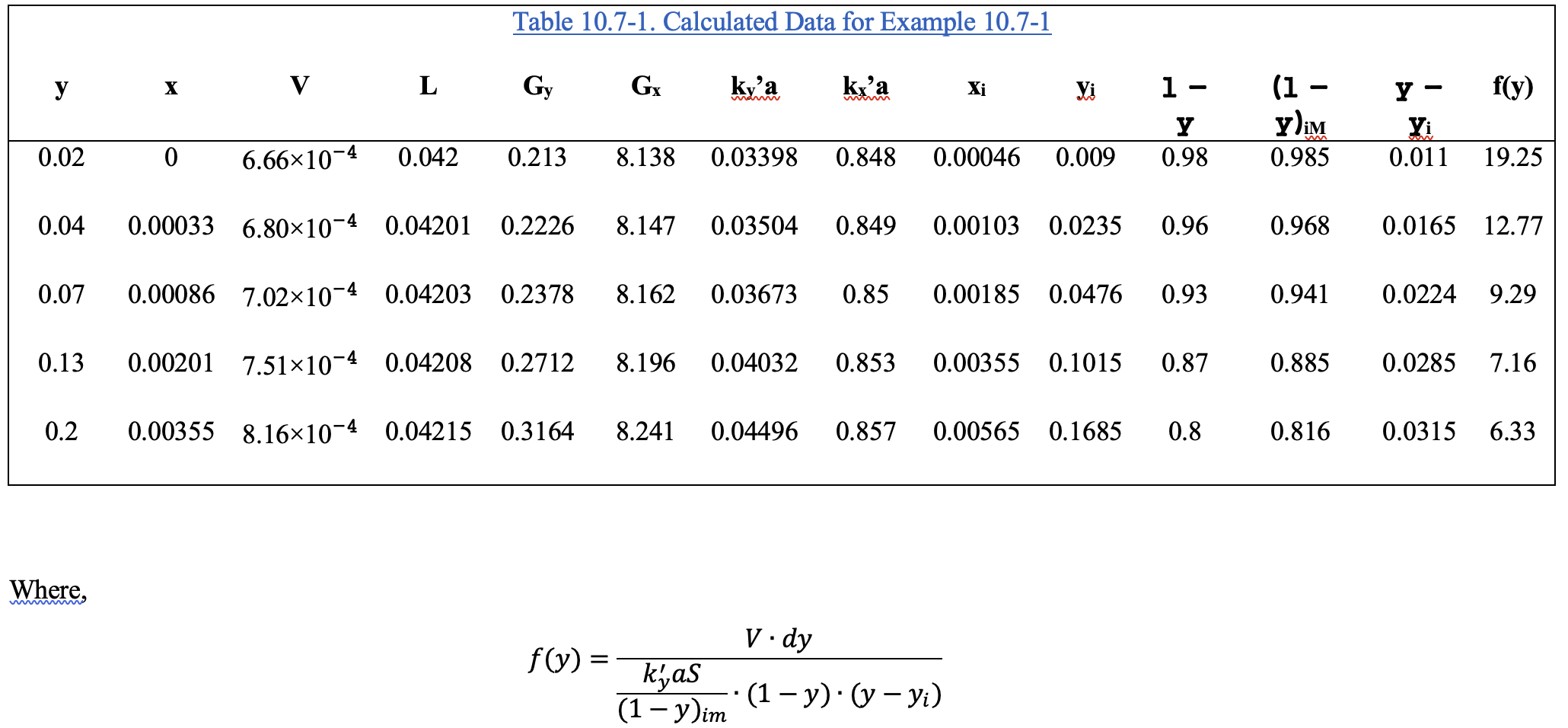
The height equation is basically integration of a function \(f(y)\) over the column. Manual integration using trapezoidal rule usually require at least 5 points along \(y\)
\[\begin{align}
Z &= \int_{y_2}^{y_1} \frac{V dy}{\frac{k'_y a S}{(1 - y)_{im}} (1 - y)(y - y_i)} \\
&= \int_{y_2}^{y_1} f(y) dy \\
&= \sum_{j=0}^{n-1} [f(y_j) + f(y_{j + 1})] \frac{y_{j+1} - y_{j}}{2}
\end{align}\]
![]()
Example 2: operating line
![]()
Example 2: textbook solutions (1)
![]()
Example 2: textbook solutions (2)
![]()
Final integration result: \(Z = 1.588\) m
Summary
In this lecture we have seen how the height of a realistic packed bed tower is calculated and how to obtain relative statements using the transfer unit concepts.
In next weeks, we will talk about the final topic: mass transfer coupled with heat transfer. One useful example will be the humidification tower.