CHE 318 Lecture 10
Unsteady State Mass Transfer (II)
2026-01-26
Midterm exam announcement
- Date: Feb 09, 2026 (Monday)
- Time: 50 min during class
- Question types:
- Multichoice questions (conceptual, no derivation)
- Short-answer questions (conceptual, no derivation)
- Long-answer questions (derivation and / or calculation)
- Formula sheet / calculator policy: refer to course syllabus
Midterm exam questions
- Covers up to unsteady state mass transport
- Sample questions to be released this week on Canvas
- Use our AI helper wisely!
Recap
- Unsteady state mass transfer: \(\partial c_A/\partial t \neq 0\)
- Mass balance equation: [In] - [Out] + [Gen] = [Acc]
- Flux equation: \(N_A = J_{Az}^{*} + c_A/c_T * (N_A + N_B)\)
- General expression for U.S.S. M.T. in 3D vector
- Boundary conditions and initial conditions
Learning outcomes
After this lecture, you will be able to:
- Recall the steps used to formulate unsteady-state mass balances.
- Identify boundary and initial conditions for typical 1D mass transfer problems.
- Apply coupled balance-and-flux equations to transient diffusion examples.
- Describe time-dependent concentration profiles in unsteady-state systems.
B.C. case 1. concentration at surfaces
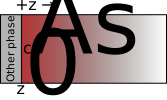
Concentration at phase interfaces
- Interface can be gas|liquid, liquid|solid, gas|solid
- Often assuming equilibrium
\[ c_{A}\vert_{\text{surf}} = c_{As}\qquad\text{eq. solubility} \]
B.C. case 2: chemical reactions
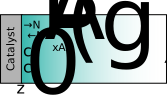
Boundary condition for reaction
\[\begin{align} N_A\big|_{\text{surf}} = \nu_A\, r_A \end{align}\]- Surface reaction couples mass transfer and kinetics
- Molar flux at surface determined by reaction rate
- Generally Neumann boundary
- \(\nu_A\): stoichiometric ratio
B.C. case 3: constant flux
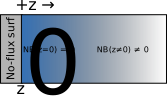
Constant flux B.C.
- In many cases the flux \(N_{A, \text{surf}}\) or \(N_{B, \text{surf}}\) can be constant.
- E.g. inpenetratable surface to stagnant gas \(N_{B, \text{surf}} = 0\)
- Does not mean \(N_{A}(z)\) or \(N_B(z)\) elsewhere is constant!
U.S.S example 1: diffusion through stagnant B
We have seen in previous examples how to solve the molar flux of liquid evaporating into stagnant air. Let’s see the same system but in unsteady state.
Question: liquid (A) evaporates inside stagnant air (B) inside a vertical tube at constant temperature \(T\) and pressure \(p_T\). At the vent of the system dry air is continuous blown. Plot the molar fraction \(x_A\) as a function of \(z\) and time \(t\). Assume the liquid level is \(L\) away from the vent and does not change during the evaporation process.
Step 1: species mass balance (unsteady, 1D)
For a differential slice \(A\,dz\), write the mass balance
\[\begin{align} \text{[IN]} - \text{[OUT]} &= \text{[ACC]} \\ A N_A \vert_{z=z} - A N_A \vert_{z=z+\Delta z} &= \frac{\partial}{\partial t}\left(A\,dz\,c_A\right) \\ -\frac{\partial N_A}{\partial z} = \frac{\partial c_A}{\partial t} \end{align}\]We would have \(\frac{\partial c_B}{\partial t} = -\frac{\partial N_B}{\partial z}\)
Step 2: couple with flux equation
This is a diffusion through stagnant B case, we can directly write
\[\begin{align} N_A(z, t) = -c_T D_{AB}\frac{\partial x_A(z, t)}{\partial z} + x_A \left[N_A(z, t) + N_B(z, t)\right] \end{align}\]- Can we use \(N_B=0\) in this case?
- No, \(N_B\) changes by \(z, t\)!
- \(N_B=0\) only at \(z=0\) (liquid interface)
- Do not write the steady state \(N_A\) solution!
Step 3: conservation equations
Generally, we still need to know the relation between \(N_A\) and \(N_B\) to solve the mass-balance-flux equations.
The total concentration \(c_T=c_A + c_B\) is conserved, therefore we have constraints
\[\begin{align} \text{[In]}_{T} - \text{[Out]}_{T} &= 0 \\ \text{[In]}_A - \text{[Out]}_A &= -\text{[In]}_B + \text{[Out]}_B \\ \frac{\partial N_A(z, t)}{\partial z} &= -\frac{\partial N_B(z, t)}{\partial z} \end{align}\]Step 4: boundary conditions
Boundary conditions (Left, Right, any time)
- \(x_A(0, t) = x_{A0}\) (equilibrium vapor fraction)
- \(x_A(L, t) = 0\) (dry air)
- \(N_B(0, t) = 0\) (No-flux boundary for B)
The last B.C for \(N_B(0, t)\) gives:
\[\begin{align} N_A(0, t) = -\frac{c_T D_{AB}}{1 - x_{A0}}\frac{\partial x_A(0, t)}{\partial z} \end{align}\]Step 5: final solution
- Unsteady state flux equation (stagnant B)
- Governing equation for diffusion through stagnant B, unsteady state:
- Analytical solution exists, but numerical solution is more convenient
U.S.S diffusion through stagnant B: analytical solution
\(x_A{z, t}\) has an analytical solution if \(L \rightarrow \infty\) (See Bird. Transport Phenomena Ch 20.1):
\[\begin{align} x_A(z, t) = x_{A0} \frac{1 - \operatorname{erf}\!(\frac{z}{\sqrt{4 D_{AB} t}} - \phi)}{1 + \operatorname{erf}\!\phi} \end{align}\]\(\operatorname{erf}\) is the error function:
\[\begin{align} \operatorname{erf}(\eta) = \frac{2}{\sqrt{\pi}} \int_{0}^{\eta} e^{-s^2}\,ds \end{align}\]- \(\phi\): a dimensionless constant depending on \(x_{A0}\), \(t\) and \(D_{AB}\)
- Scaling combining length and time: \(\frac{z}{\sqrt{4D_{AB}t}}\)
- Higher \(D_{AB}\) 👉 faster towards steady state! (Wooclap question 3, L09)
- Penetration depth: \(L_p \approx \sqrt{4D_{AB} t}\)
Numerical solutions to evaporation problem
The numerical solution using finite difference (FD) methods is beyond CHE 318, but we can briefly breakdown the process into:
- Discretize space: \(z \rightarrow z_i\)
- Approximate spatial derivatives with finite differences
- Convert PDE into a system of ODEs in time
- Integrate in time using standard ODE solvers
U.S.S diffusion through stagnant B: demo
U.S.S example 2: transport through a catalyst wall
Question: A gas mixture containing species A flows through a cylindrical conduit of diameter \(D\) with a constant mean velocity \(v_m\). A porous catalytic wall of thickness \(\Delta z\) is located at a fixed axial position inside the conduit. Inside the catalyst region, species A is consumed by a first-order surface reaction:
\[ r = k'(c_{A,s} - c_A) \]
Assume:
- surface concentration on catalyst, \(c_{A,s}\) is constant
- uniform properties in the radial direction
- constant \(T\), \(P\), and physical properties
- no reaction outside the catalyst region
Step 1: mass balance
Consider a differential gas-phase control volume of thickness \(\Delta z\) that intersects the catalytic wall.
\[\begin{align} \text{In} - \text{Out} + \text{Generation} &= \text{Accumulation} \\ \\ \frac{\pi D^2}{4} \left( N_A\big|_{z} - N_A\big|_{z+\Delta z} \right) + \pi D\,\Delta z\,k'\,(c_{A,s}-c_A) &= \frac{\pi D^2}{4}\, \frac{\partial C_A}{\partial t} \\ -\frac{\partial N_A}{\partial z} + \frac{4k'}{D}\,(c_{A,s}-c_A) = \frac{\partial c_A}{\partial t} \end{align}\]Step 2: coupling with flux equation
Use the convection–diffusion flux (constant \(v_m\)):
\[\begin{align} N_A = -\,D_{AB}\,\frac{\partial c_A}{\partial z} + c_A\,v_m \end{align}\]When \(v_m\) is constant, differentiate over \(N_A\) becomes:
\[\begin{align} \frac{\partial N_A}{\partial z} = -\,D_{AB}\,\frac{\partial^2 c_A}{\partial z^2} + v_m\,\frac{\partial c_A}{\partial z} \qquad (v_m=\text{const}) \end{align}\]Step 3: general equation for M.T + surface reaction
\[\begin{align} \frac{\partial c_A}{\partial t} &= -\left( -\,D_{AB}\,\frac{\partial^2 c_A}{\partial z^2} + v_m\,\frac{\partial c_A}{\partial z} \right) + \frac{4k'}{D}\,(c_{A,s}-c_A) \\ &= D_{AB}\,\frac{\partial^2 c_A}{\partial z^2} - v_m\,\frac{\partial c_A}{\partial z} + \frac{4k'}{D}\,(c_{A,s}-c_A) \end{align}\]Need:
- initial condition \(c_A(z,0)\)
- boundary conditions at \(z=0\) and \(z=L\)
Solve:
- analytical (special cases)
- numerical integration (finite difference)
Summary
- Step-by-step solution to diffusion through stagnant B
- Diffusion and reaction system setup