MATE 664 Lecture 11
Diffusion in Defect and Material Imperfections
2026-02-09
Recap of Lecture 10
Key ideas from last lecture:
- Diffusion equations for solids
- Link Einstein’s equation to Arrhenius equation
- Emergence of activation enthalpy / entropy
- Vacancy formation free energy and diffusion
Learning outcomes
After this lecture, you will be able to:
- Apply the free energy-dependent diffusion equations to systems with defects and material imperfections
- Understand how intrinsic and extrinsic defect in ionic materials are formed
- Analyze intrinsic / extrinsic diffusion regimes in ionic materials
- Understand material imperfections as the diffusion shortcuts
What does diffusion in real materials look like?
- Real solids are not perfect crystals
- Defects control transport properties
- Ionic diffusion shows rich temperature dependence
- Same Einstein framework, new physics inside
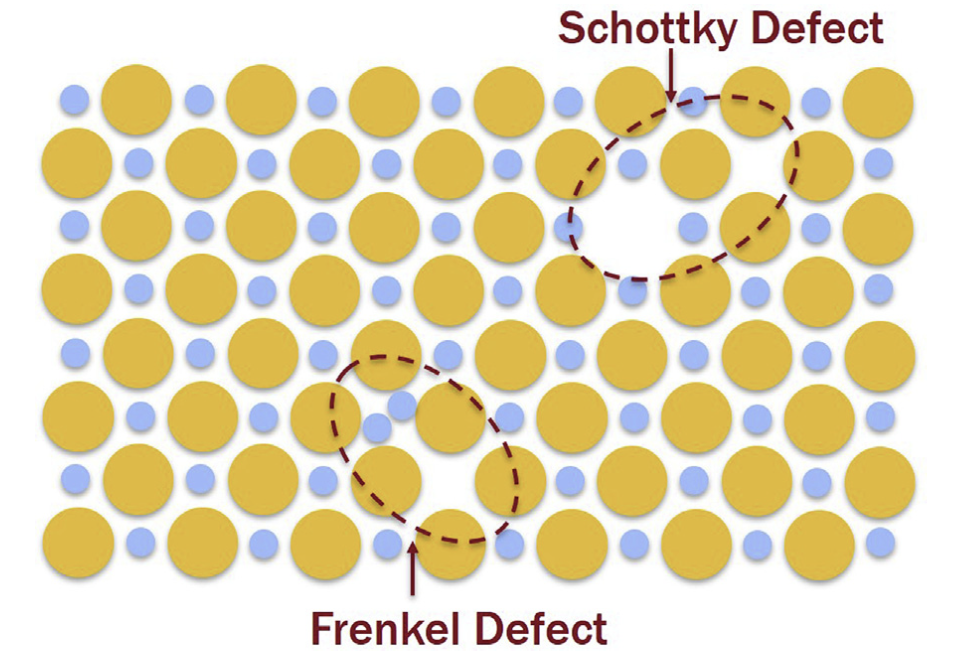
Schottky and Frenkel defects in ionic crystals
- Schottky defects: missing both positive and negative species
- Frenkel defects: one charged species moved to other site
![]()
Comparison between Schottky and Frenkel defects
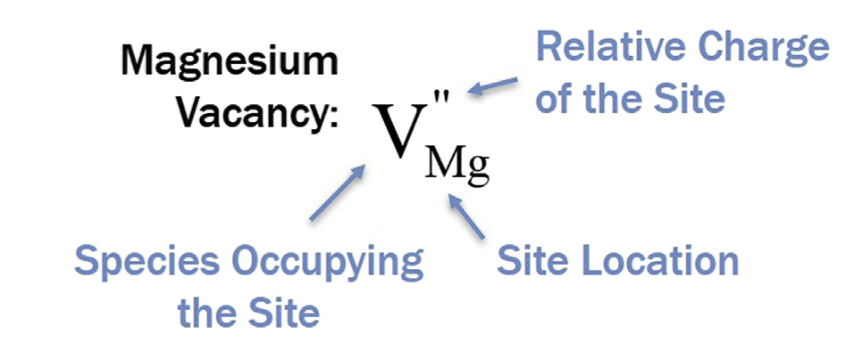
Ionic defects: Kröger-Vink (KV) notation
- Formula \(X^Z_Y\)
- X = what is at the site (Element or Vacancy)
- Y = what site is defective (Element or i)
- Z = effective charge at the site (• = +; ’= –)
![]()
Example of KV notation
KV notation for Schottky defects
Example: Schottky defects in MgO (anion + cation vacancies)
Formation reaction
\[
\text{null} \rightarrow V_{\mathrm{Mg}}^{''} + V_{\mathrm{O}}^{\bullet\bullet}
\]
Equilibrium condition
- \(G_S^f\): formation free energy for Schottky defects (per reaction)
\[
K_S = [V_{\mathrm{Mg}}^{''}][V_{\mathrm{O}}^{\bullet\bullet}]
= \exp\!\left(-\dfrac{G_S^{f}}{kT}\right)
\]
Charge neutrality
\[
[V_{\mathrm{Mg}}^{''}] = [V_{\mathrm{O}}^{\bullet\bullet}]
\]
KV notation for Frenkel defects
Example: Frenkel pairs in LiF (Lithium escaping to interstitial sites)
Formation reaction
\[
\mathrm{Li}_{\mathrm{Li}}^{\times} \rightarrow V_{\mathrm{Li}}^{'} + \mathrm{Li}_i^{\bullet}
\]
Equilibrium condition
- \(G_F^f\): formation free energy for Schottky defects (per reaction)
\[
K_F = [V_{\mathrm{Li}}^{'}][\mathrm{Li}_i^{\bullet}]
= \exp\!\left(-\dfrac{G_F^{f}}{kT}\right)
\]
Charge neutrality
\([V_{\mathrm{Li}}^{'}] = [\mathrm{Li}_i^{\bullet}]\)
Intrinsic vs extrinsic defects
- Intrinsic defects are those controlled by thermodynamics \(G_S^f\), \(G_F^f\) or \(G_V^f\)
- Extrinsic defects are those defects added to the ionic crystal via doping
Example of Extrinsic defects: CdCl\(_2\) in NaCl
Dopant incorporation reaction
\[
\mathrm{CdCl}_2 \rightarrow \mathrm{Cd}_{\mathrm{Na}}^{\bullet}
+ 2\,\mathrm{Cl}_{\mathrm{Cl}}^{\times}
+ V_{\mathrm{Na}}^{'}
\]
Extrinsic defect concentration
\[
[V_{\mathrm{Na}}^{'}]_{\text{ext}}
= [\mathrm{Cd}_{\mathrm{Na}}^{\bullet}]
= [\mathrm{CdCl}_2]
\]
Total vacancy concentration
\[
[V_{\mathrm{Na}}^{'}]
\approx [V_{\mathrm{Na}}^{'}]_s + [V_{\mathrm{Na}}^{'}]_{\text{ext}}
= \frac{\exp\!(-\dfrac{G_S^{f}}{k_B T})}{ [\mathrm{CdCl}_2]} + [\mathrm{CdCl}_2]
\]
Diffusivity of ionic species
- We can still use the vacancy exchange mechanism for the diffusivity of ionic species
- For f.c.c. lattice the neighbor sites of same charge, the multiplicity \(z=6\).
- E.g. Na\(^+\) exchanges with its own vacancy \(V_{\mathrm{Na}}^{'}\)
- \([V_{\mathrm{Na}}^{'}]\) depends on the \(T\)-regime!
\[\begin{align}
D_{\mathrm{Na}}
&= [V_{\mathrm{Na}}^{'}]\,
f\,\lambda^2\,\nu\,
\exp\!\left(-\frac{G_{\mathrm{Na}}^{m}}{kT}\right)
\end{align}\]
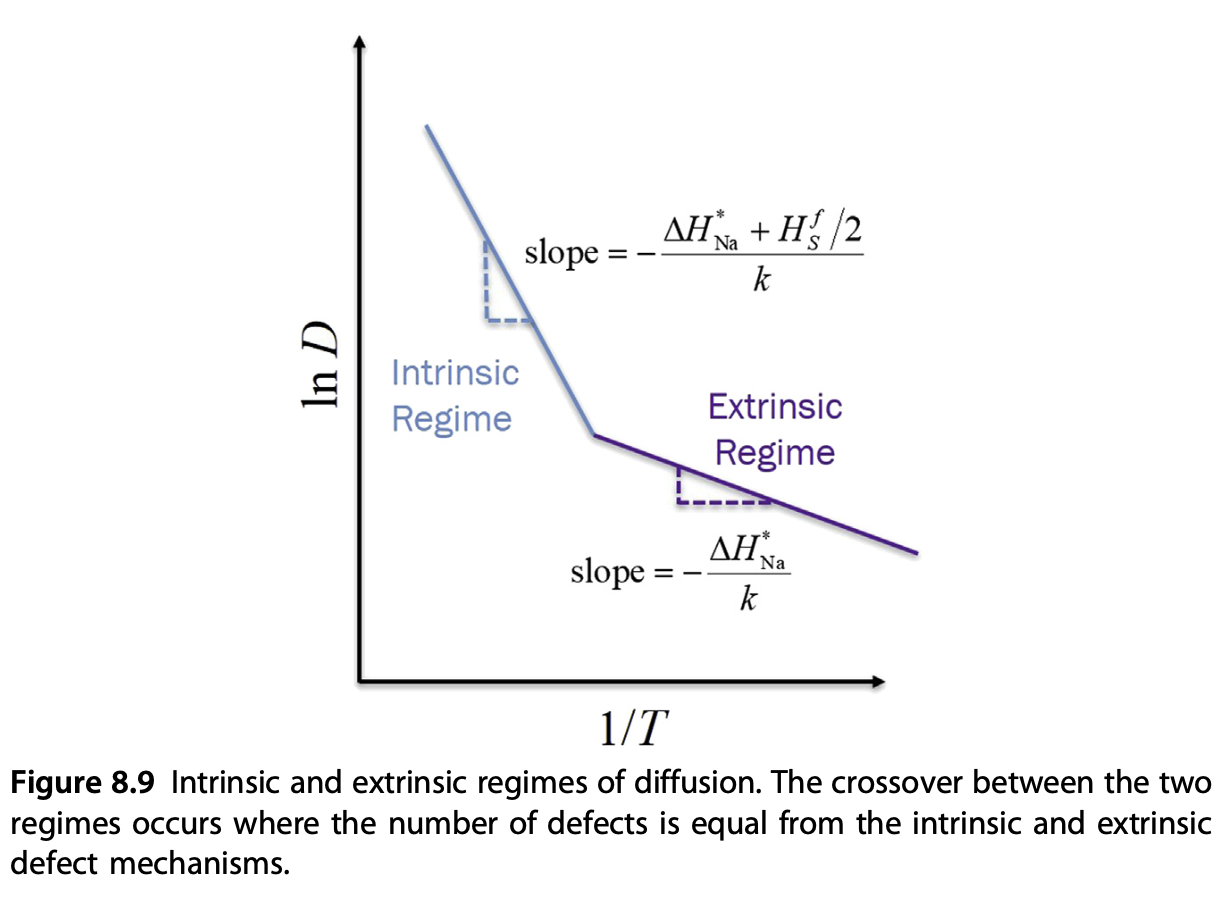
Intrinsic vs extrinsic regimes
- Extrinsic: vacancy dominated by doped materials
- Low-\(T\) regime (high \(1/T\))
\[\begin{align}
D_{\mathrm{Na,ext}}
&= [\mathrm{CdCl}_2]\,
f\,\lambda^2\,\nu\,
\exp\!\left(\frac{S_{\mathrm{Na}}^{m}}{k}\right)
\exp\!\left(-\frac{H_{\mathrm{Na}}^{m}}{kT}\right)
\end{align}\]
- Intrinsic: vacancy dominated by thermal dissociation
- High-\(T\) regime (low \(1/T\))
\[\begin{align}
D_{\mathrm{Na,int}}
&= f\,\lambda^2\,\nu\,
\exp\!\left(\frac{S_{S}^{f}}{2k}\right)
\exp\!\left(\frac{S_{\mathrm{Na}}^{m}}{k}\right)
\exp\!\left(-\frac{H_{S}^{f}}{2kT}\right)
\exp\!\left(-\frac{H_{\mathrm{Na}}^{m}}{kT}\right)
\end{align}\]
Two-regimes in the Arrhenius plot
![]()
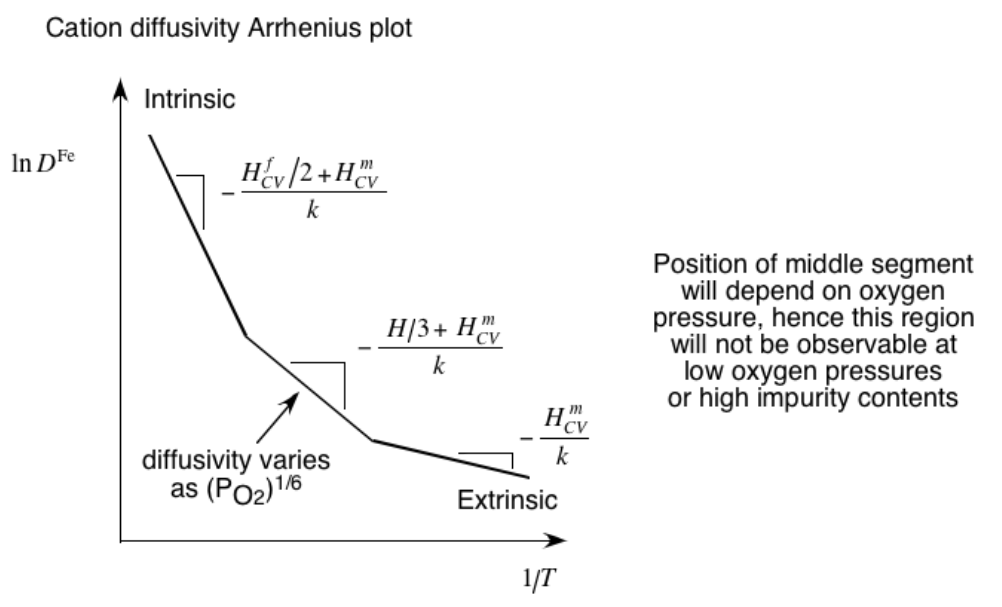
More regimes in Arrhenius plot
- Example: cation diffusion in FeO during oxidation
- Equilibrium depends on both \(G^f\) and \(p(O_2)\)
- Multiple regimes!
![]()
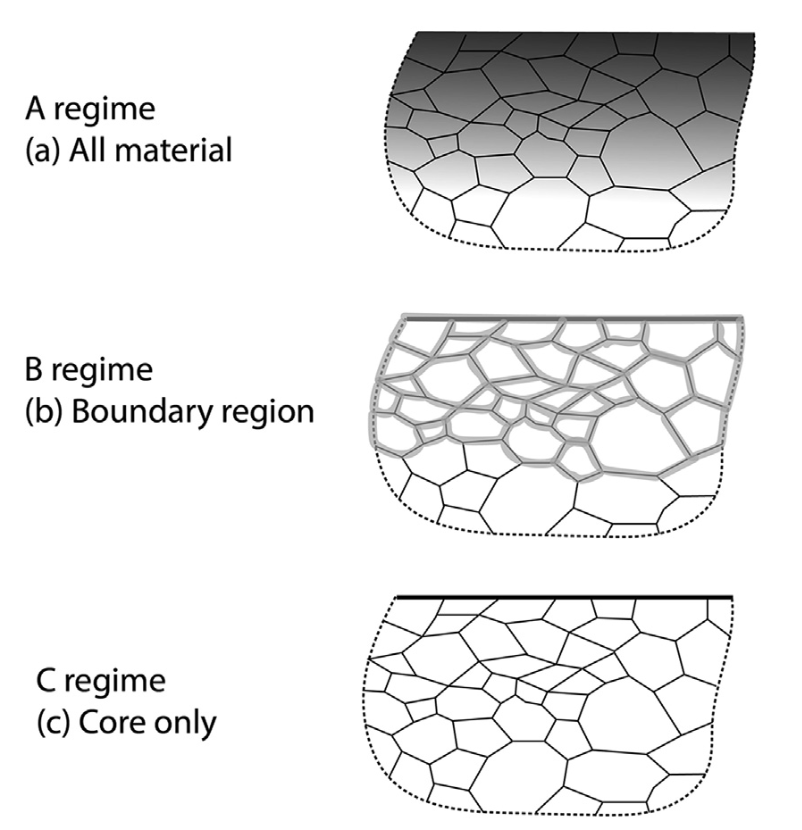
Multiple-regime diffusion in polycrystalline materials
![]()
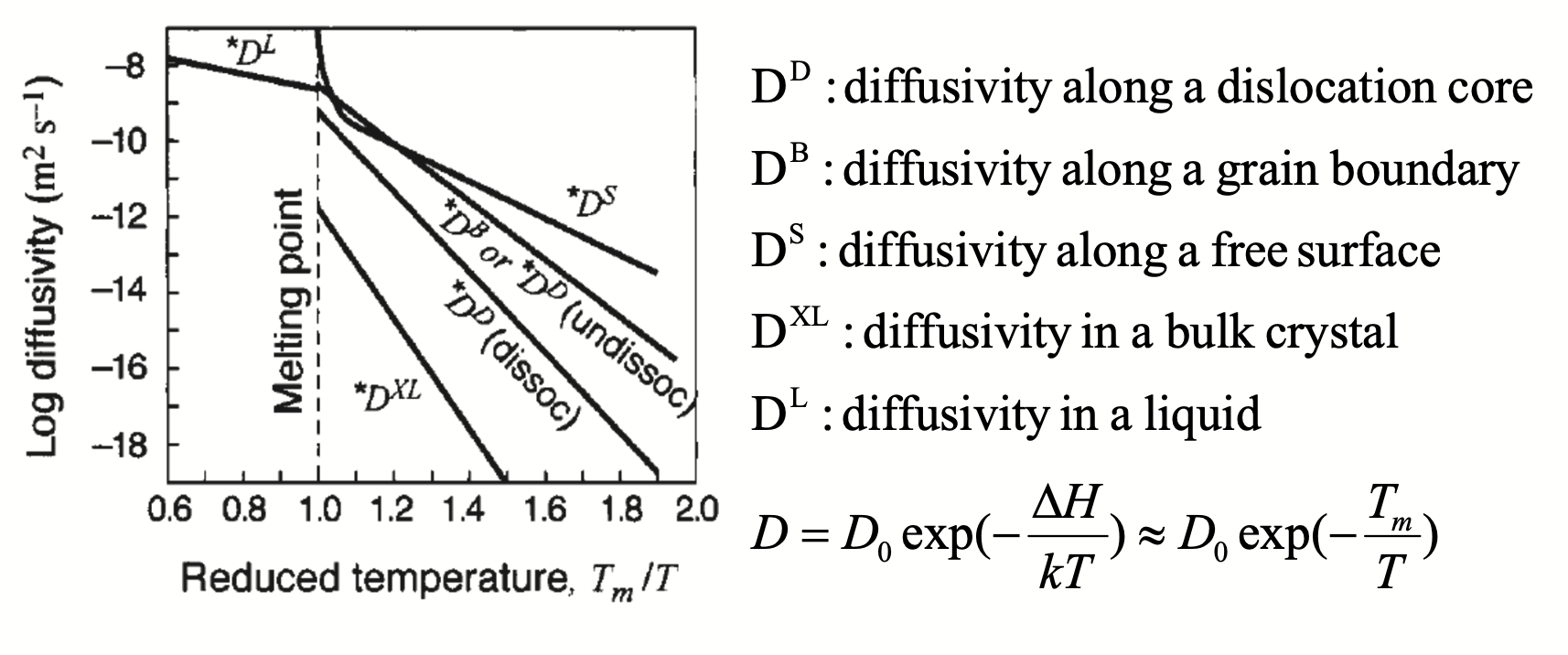
Arrhenius plot for diffusion on imperfections
Diffusion paths at crystal imperfections
- Diffusion can occur along non-bulk pathways
- Typical crystal imperfections
- Grain boundary and interface diffusion: 2D
- Free surface diffusion: 2D
- Dislocation (pipe) diffusion: 1D
- Vacancy / defect: 0D
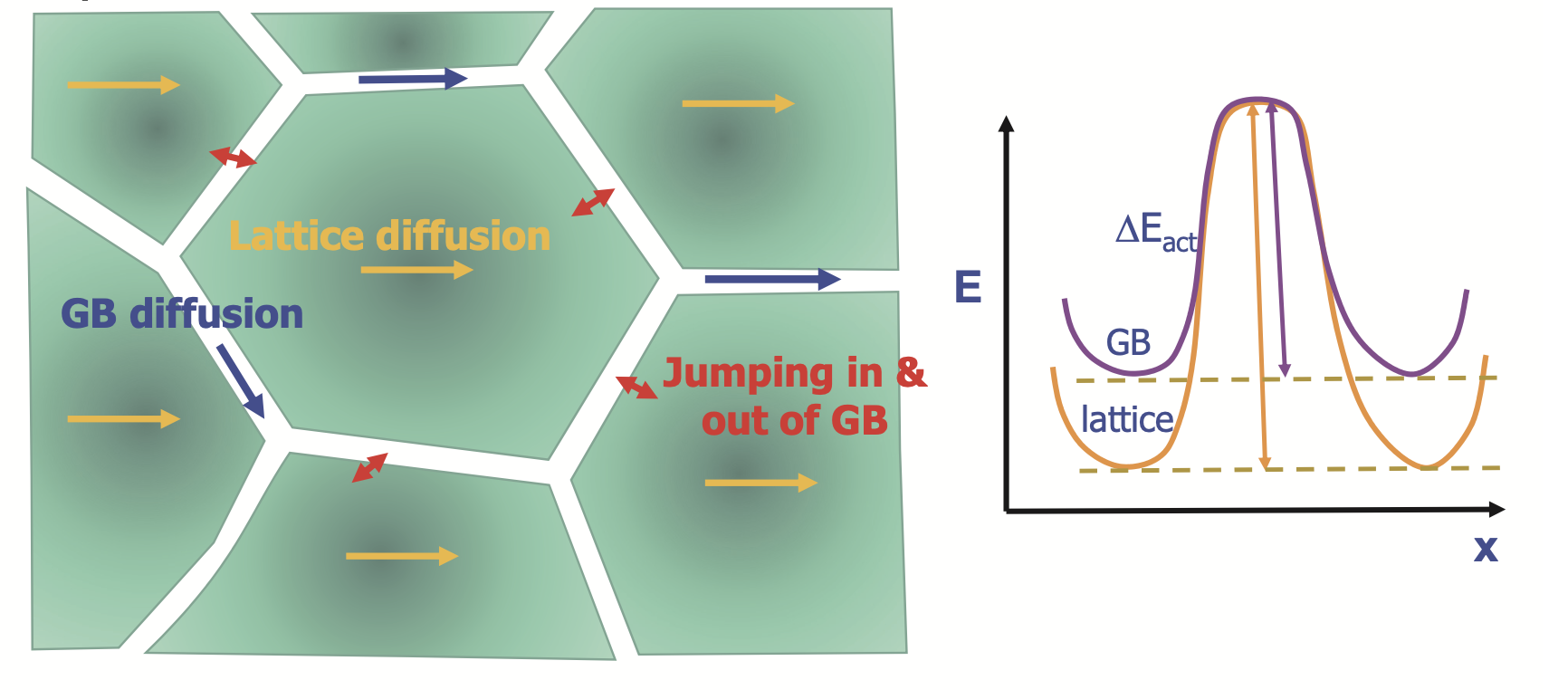
- Imperfections are associated with lower migration / activation energy!
- Think as “shortcuts” during diffusion
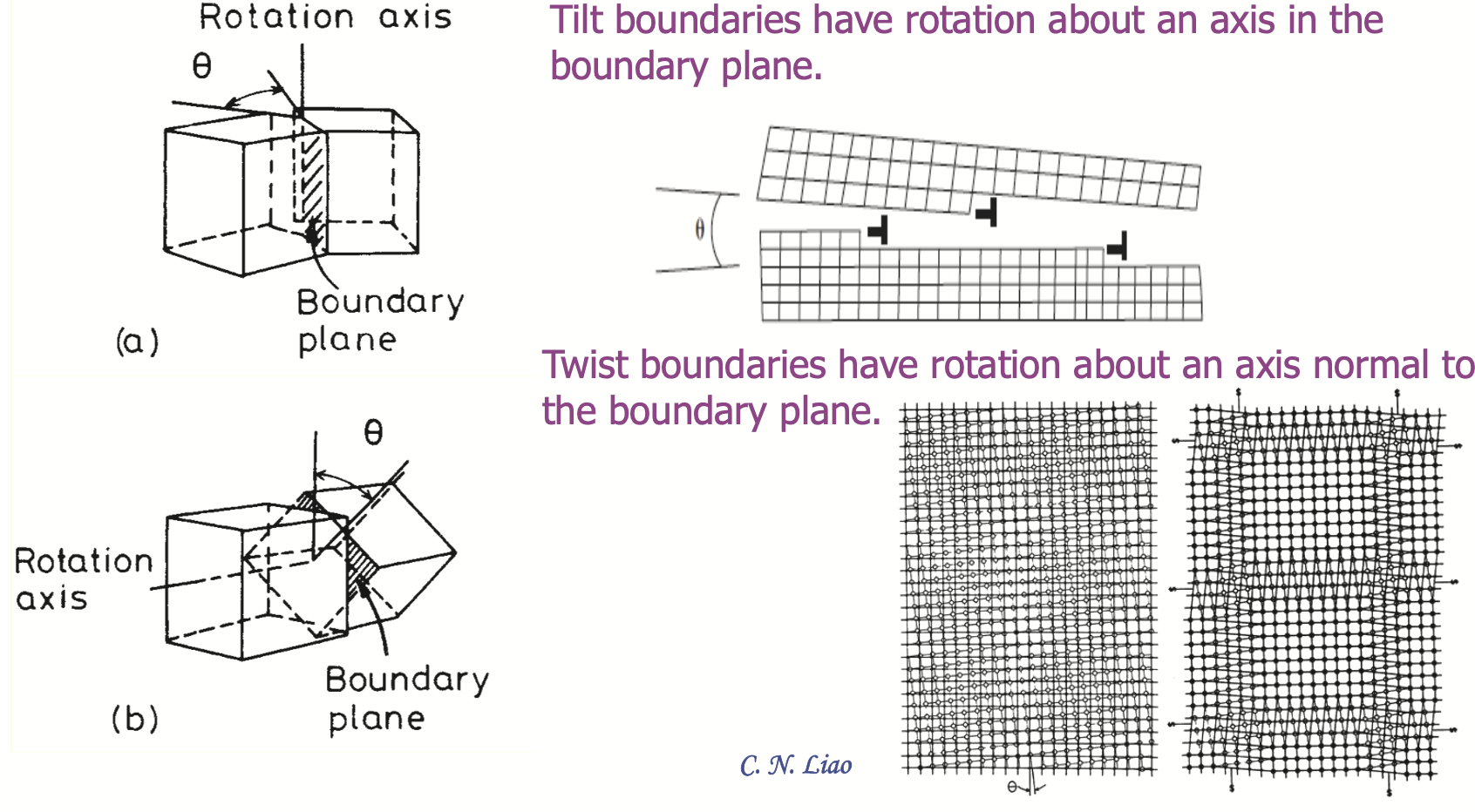
Imperfection 1: grain boundaries
![]()
Grain boundary diffusion
![]()
Harrison’s ABC model for GB diffusion
A foreign material is coated on the top of a polycrystalline metal. The degree of penetration can be studied by comparing the timescale \(t\), interatomic distance \(\lambda\) and grain size \(s\)
- All regime
- \(D_{XL} t > s^2\)
- \(D_B t > s^2\)
- Boundary regime
- \(D_{XL} t \approx \lambda^2\)
- \(D_B t > \lambda^2\)
- coupled short-circuit and bulk diffusion
- Core regime
- \(D_{XL} t < \lambda^2\)
- \(D_B t > \lambda^2\)
- diffusion confined to imperfections
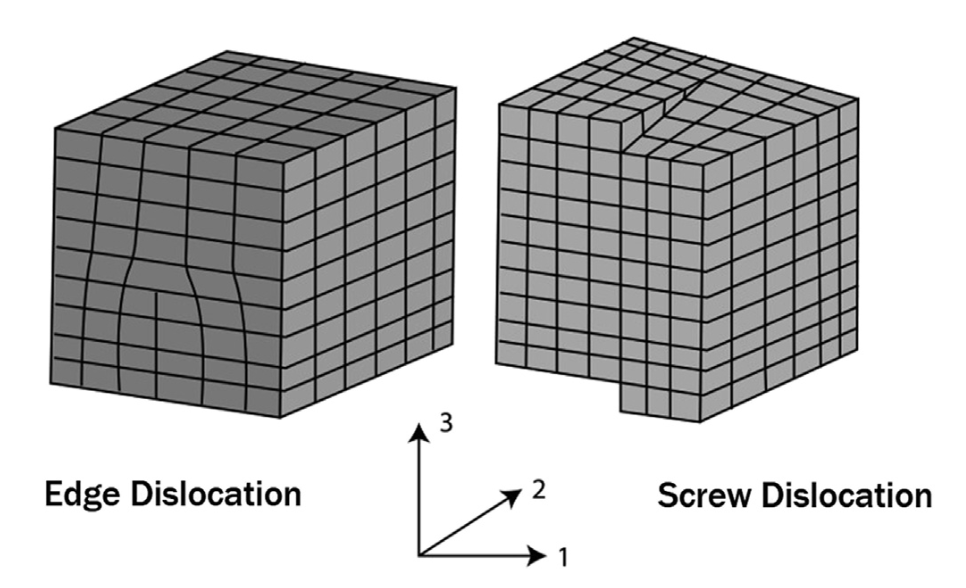
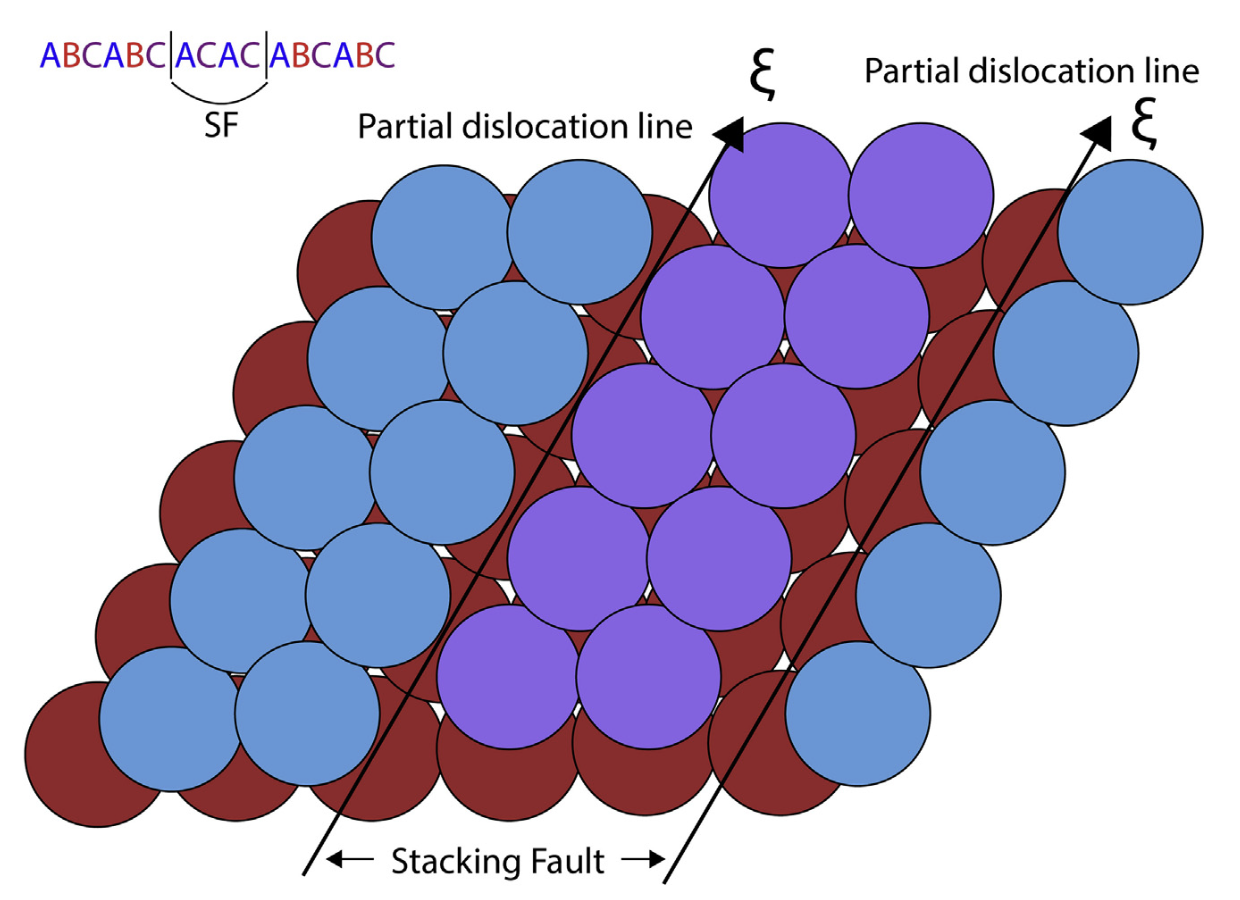
Dislocation imperfections (line defect)
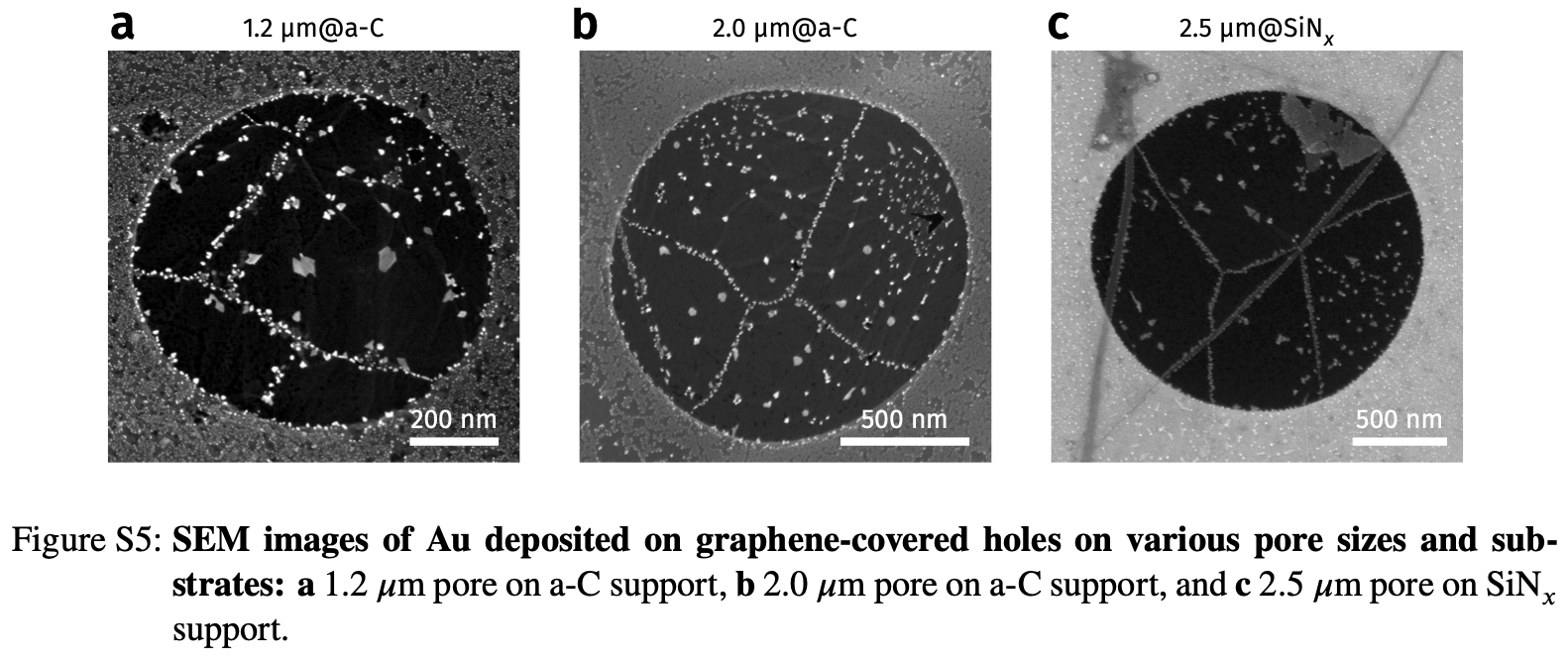
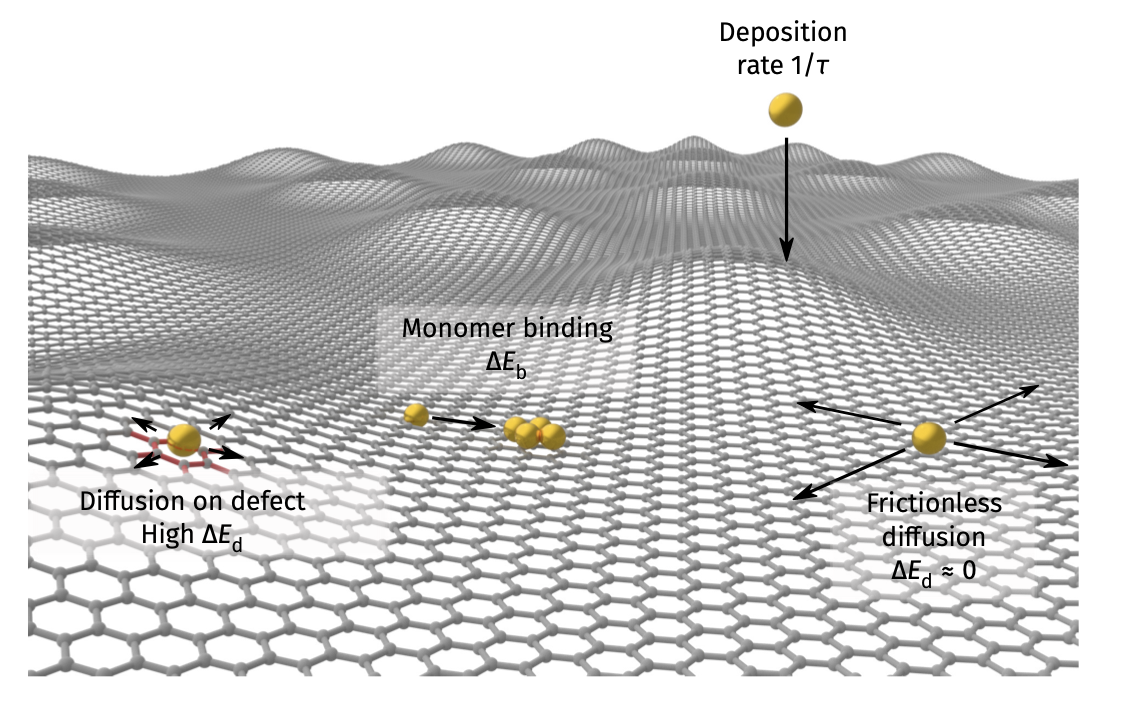
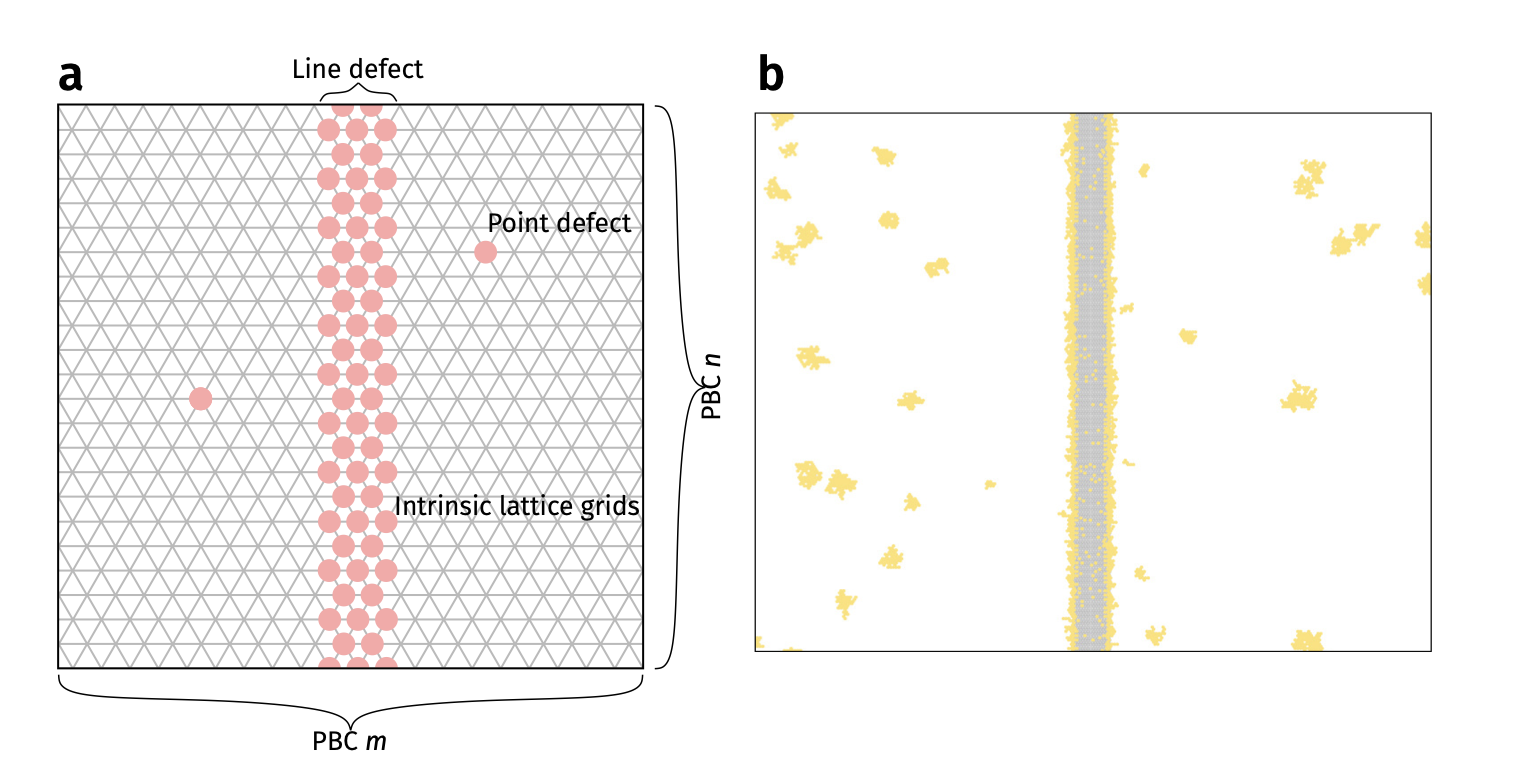
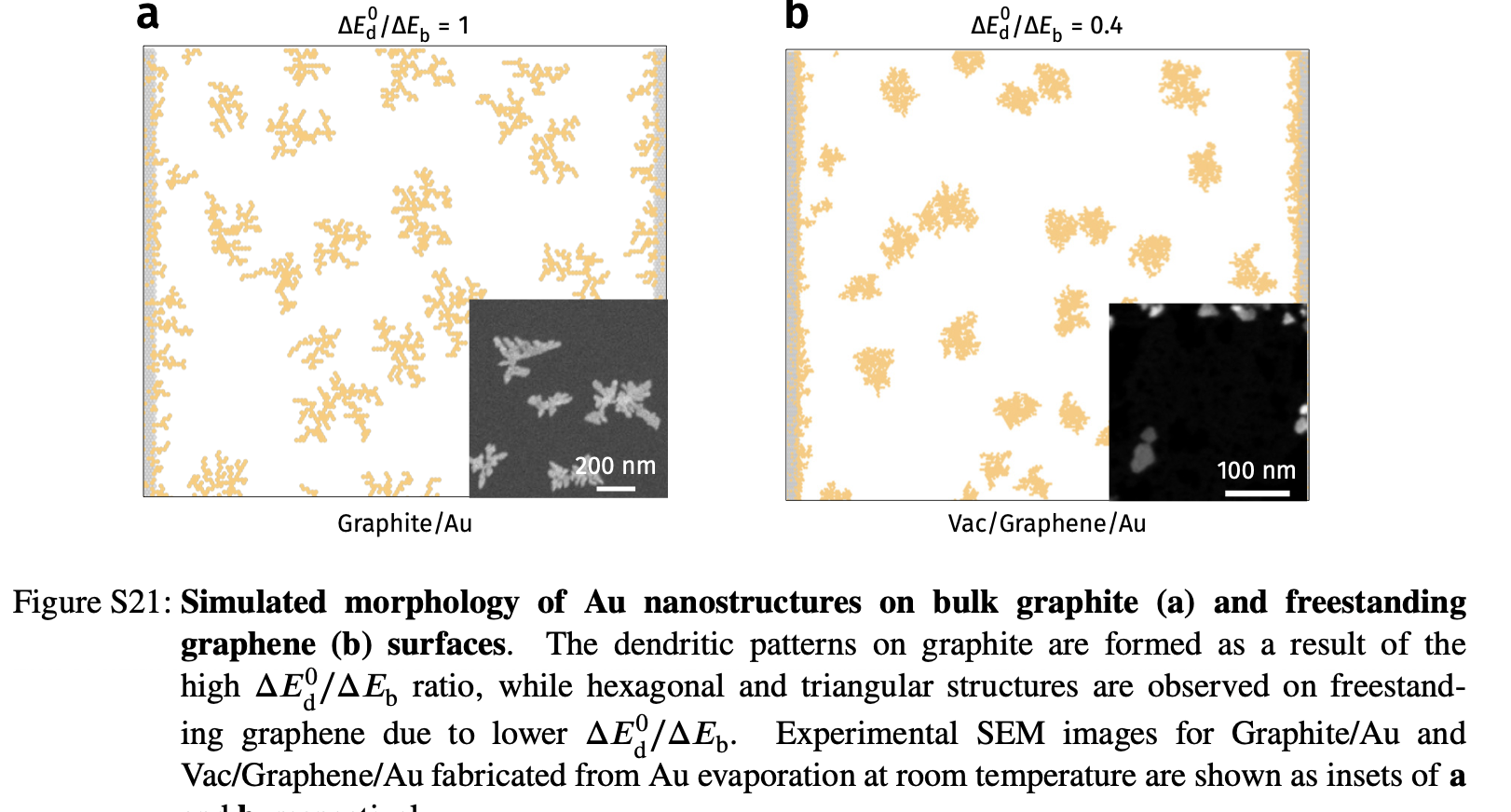
Example of diffusion along imperfection: deposition on graphene
- See Vagli and Tian et al. Nat Commun 2025, 16, 7726.
- Diffusivity change on free graphene surface can be probed by deposition geometry!
![]()
Deposition on Graphene - theoretical simulations
- Kinetic Monte Carlo (kMC) assuming different diffusion barrier on imperfections
- Faster diffusion direction –> lower density
![]()
Deposition on Graphene - theoretical simulations
- Kinetic Monte Carlo (kMC) assuming different diffusion barrier on imperfections
- Faster diffusion direction –> lower density
![]()
Deposition on Graphene - KMC vs experiments
![]()
Summary
In this lecture, we reviewed a few sample cases where diffusion is dominated by crystal defects and imperfections
- Diffusion by ionic defects – multiple Arrhenius regimes
- Diffusion by imperfections – shortcut diffusion compared with bulk diffusion
- Example of interface mediated diffusion – 2D material