MATE 664 Lecture 14
Introduction To Nucleation Theory
2026-02-25
Learning outcomes
After this lecture, you will be able to:
- Identify the driving force when a system becomes supercooled or supersaturated
- Describe the difference between discontinuous and continuous phase transformations
- Analyze the nucleation free energy barrier \(\Delta G_c\)
- Describe the role of surface and interfacial energy in nucleation
- Describe the pseudo-steady-state kinetic model for nucleation
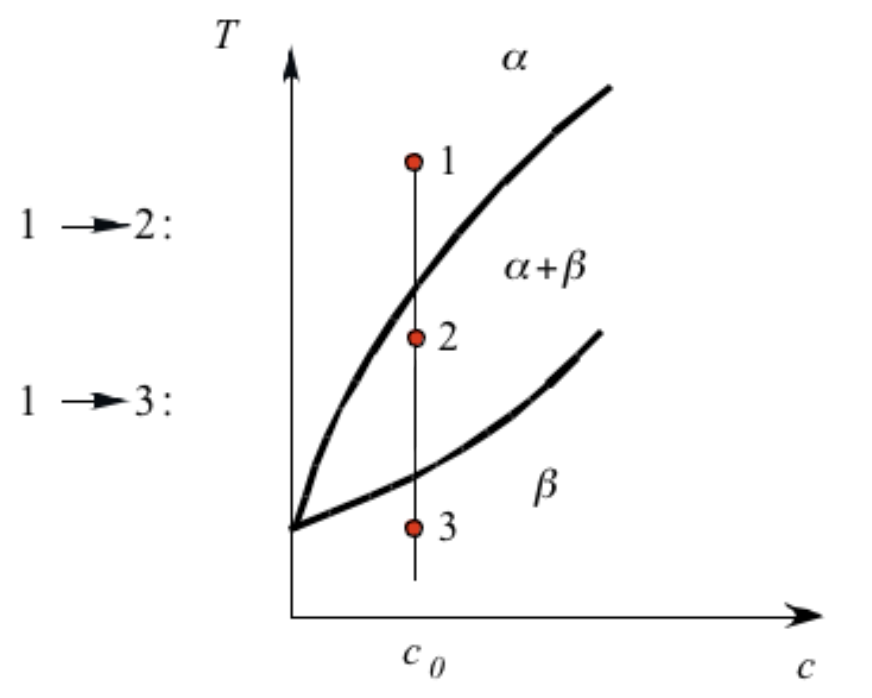
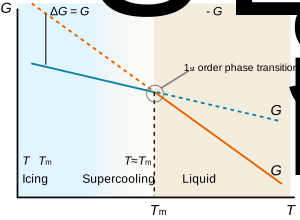
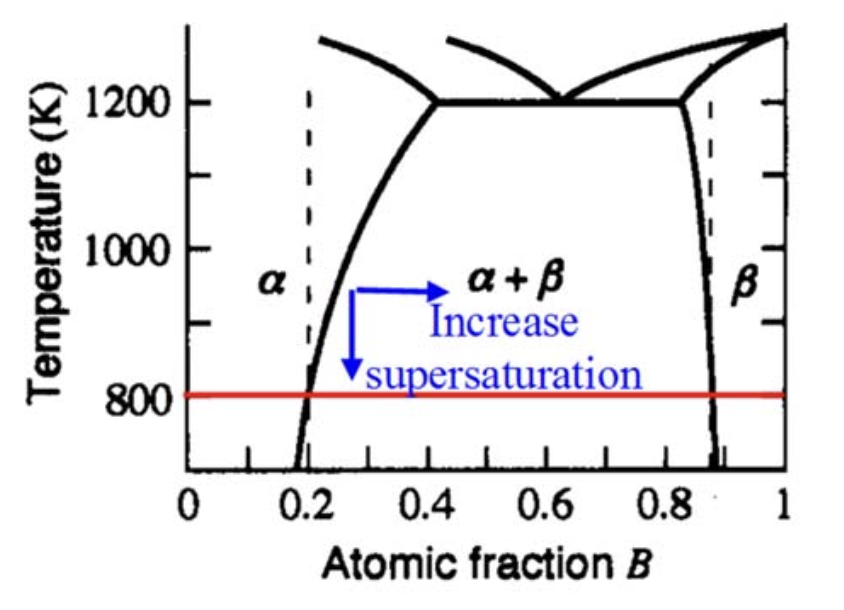
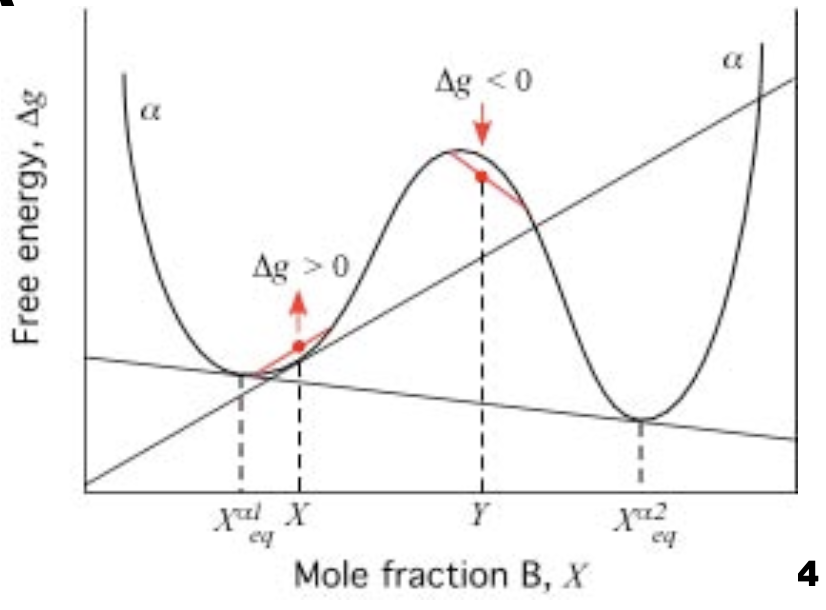
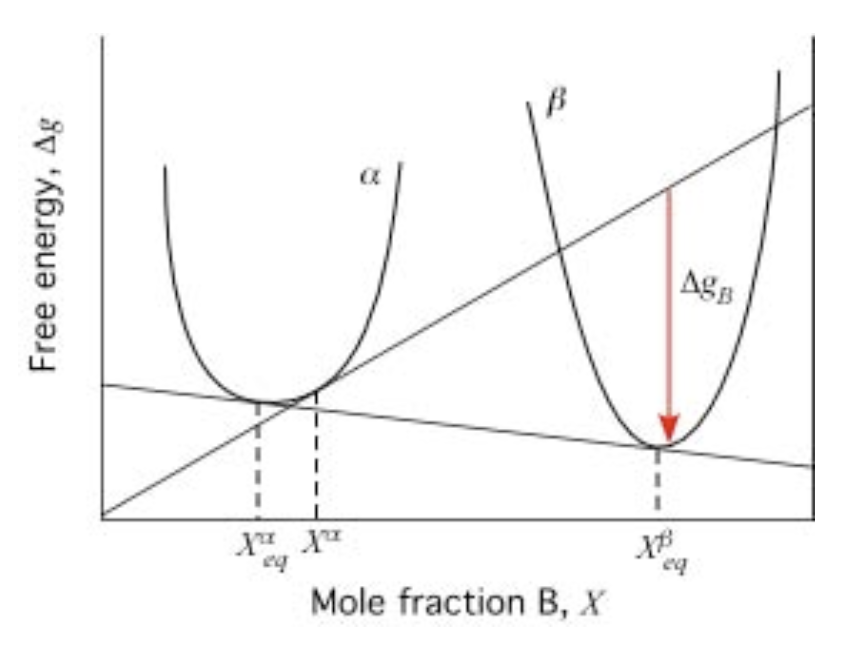
Phase-diagram in non-equilibrium region
- How to induce phase transformation from a phase diagram?
- Going low in temperature –> (super)cooling
![]()
Nucleation theory in a nutshell
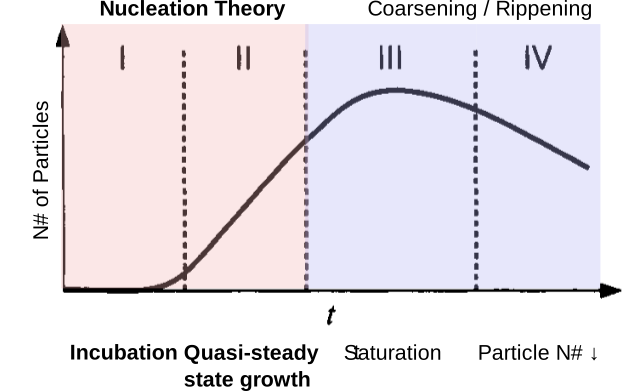
- Crystal growth can be divided in 4 regions
- Nucleation theory deals with regions I and II (incubation & pseudo-steady-state)
![]()
Introducing interfacial energy (1)
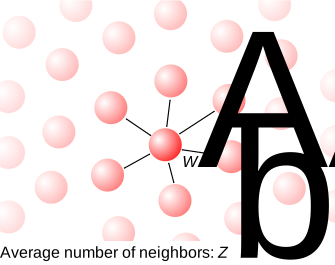
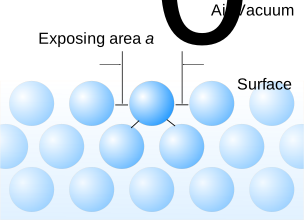
Creating interfaces between different atoms causes energy to change!
Surface energy \(\gamma_A\) (vacuum, unit J/m\(^2\) or N/m)
\[
\gamma_A = \frac{1}{2 a_0} w_{AA} (Z_s - Z_b)
\]
Interatomic energy in bulk
![]()
Creation of surface
![]()
Introducing interfacial energy (2)
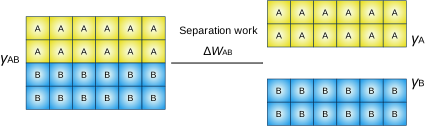
Interfacial energy \(\gamma_{AB}\) can be calculated using \(\gamma_A\) \(\gamma_B\) and \(\Delta W_{AB}\)
If adhesion between A and B are not strong, interface unlikely to form!
\[
\gamma_{AB} = \gamma_A + \gamma_B - \Delta W_{AB}
\]
![]()
Nucleation theory: overall nucleation free energy
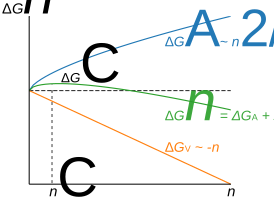
- Nucleation free energy has bulk and interface parts
\[\begin{align}
\Delta G_N &= \Delta G_N^{\text{bulk}} + \Delta G_N^{\text{interfacial}} \\
&= n (\mu^\beta - \mu^\alpha) + \eta n^{2/3} \gamma_{\alpha \beta} \\
\end{align}\]
- Shape factor \(\eta = (36 \pi)^{1/3} \Omega^{2/3}\)
Different scaling between bulk & interfacial F.E.
- \(\Delta G^{\text{bulk}} \propto -n^{1.0}\)
- \(\Delta G^{\text{interfacial}} \propto +n^{2/3}\)
- Maximum \(\Delta G_c\) at \(n_c\).
- \(\partial G_c/\partial n |_{n=n_c} = 0\)
The critical nucleus size \(n_c\)
Classical homogeneous nucleation gives
\[
n_c = -\frac{8}{27} \left[\frac{\eta \gamma_{\alpha \beta}}{\mu_\beta - \mu_\alpha} \right]^3
\]
- Nucleation free energy barrier
\[
\Delta G_c = \frac{4}{27} \frac{(\eta \gamma)^3}{(\mu_\beta - \mu_\alpha)^2}
\]
Pseudo-steady-state nucleation theory
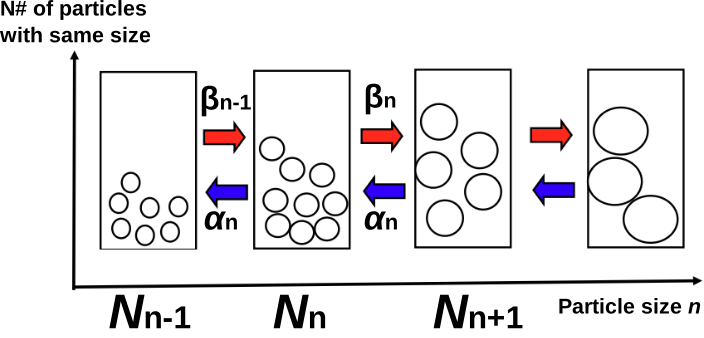
- Consider the “quasi-diffusion” in \(n\)-landscape!
![]()
Q.S.S. governing equations
- “Quasi flux” of \(n \rightarrow n+1\): \(J_n\)
- Can also model \(\partial N_n/\partial t\) from assignment 2
- At equilibrium, detailed balance follows:
\[
J_n(t) = \beta_n N_n(t) - \alpha_{n+1} N_{n+1}(t) = 0
\]
- The nucleation rate at quasi-pseudo-state can be computed using a known \(N_n\) distribution
Q.S.S. assumptions
- In a constrained equilibrium system, \(N_n\) follows the Boltzmann distribution
\[
\frac{N^{\text{ceq}}_n}{N_t} \approx \exp \left( -\frac{\Delta G_n}{k_B T} \right)
\]
\[
J_n(t) = - \beta_n \left[ \frac{\partial N_n}{\partial n} + \frac{N_n}{k_B T} \frac{\partial \Delta G_n}{\partial n} \right]
\]
- Analog: diffusion in external potential
\[
J = -L_{11} \nabla (\mu_1 + \phi) = -D_1 \left( \frac{\partial c}{\partial x} + \frac{c}{k_B T}\frac{\partial \phi}{\partial x} \right)
\]
Q.S.S. nucleation rate: final results
- Assuming the nucleation rate is determined by \(J \approx J_{n_c}\)
- \(Z\) is the Zeldovich factor (~0.1)
\[\begin{align}
J &= Z \beta_c n_t \exp(-\frac{\Delta G_c}{k_B T}) \\
Z &= \sqrt{\frac{\Delta G_c}{3 \pi n_c^3 k_B T}}
\end{align}\]
Implication of Q.S.S. nucleation rate
- Zeldovich factor is around 0.1
- Particles can shrink when they are not reaching \(n_c\)!
- Rule of thumb: \(\Delta G_c \leq 76 k_B T\), otherwise no detectable nucleation
- At \(T=298\) K, \(\Delta G_c \leq 1.95\) eV
\[\begin{align}
J &= Z \beta_c n_t \exp(-\frac{\Delta G_c}{k_B T}) \\
Z &= \sqrt{\frac{\Delta G_c}{3 \pi n_c^3 k_B T}}
\end{align}\]
Summary
- Nucleation is a type of discontinuous phase transformation that is triggered by the difference in free energy at supercooling / supersaturation
- At unsteady-state conditions, nucleation free energy barrier is caused by the positive interfacial energy
- Nucleation free energy barrier is characterized by \(\Delta G_c\), giving critical nucleus size \(n_c\)
- The evolution of particle number at each size \(N_n\) can be described by a “diffusion-like” analog
What to learn next
Is homogeneous nucleation the whole picture? Maybe not. Consider the following examples
Sugar crystal formation
![]()
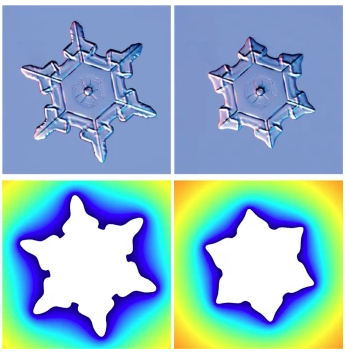
Snow formation
- Diffusion-controlled growth
![]()