MATE 664 Lecture 22
Multiscale Simulation for Kinetics of Materials (III): Molecular Dynamics (MD)
2026-03-25
Learning outcomes
After this lecture, you will be able to:
- Recall the basic idea of molecular dynamics as time integration of atomic motion
- Identify the main components of an MD simulation, including forces, integrators, and ensembles
- Describe how thermostats and timesteps affect MD simulations
- Interpret the role of interatomic potentials in molecular dynamics
Announcement: class presentation
- Date: April 8 14:00 - 17:30
- Location: HC 2-14 (same classroom)
- Format: slide presentation or your choice of media. Pre-recorded video allowed if unable to attend
- Length: 10 min presentation + 2 min questions
Recap: Monte Carlo (MC) and Kinetic Monte Carlo (KMC) methods
- (Metropolis) MC: sampling equilibrium configuration
- KMC: sampling configuration change over (pseudo) time scale
- Major assumption: average / integral of states can be performed by random sampling
- Probability ratio (NVT)
Recap: potential energy comparison in MC
The central parameter in MC / KMC simulations is the estimation of probability, or equivalent the potential energy \(E_i\) (or \(U_i\)).
Remaining questions:
- where do we get these energy values?
- if we do need to calculate force \(- \dfrac{\partial E}{\partial x}\), what can we get?
- can we get continuous motion instead of discrete states “hopping”?
Historical review: atomic hypothesis
Excerpt from Richard Feynman’s physics lecture at Caltech
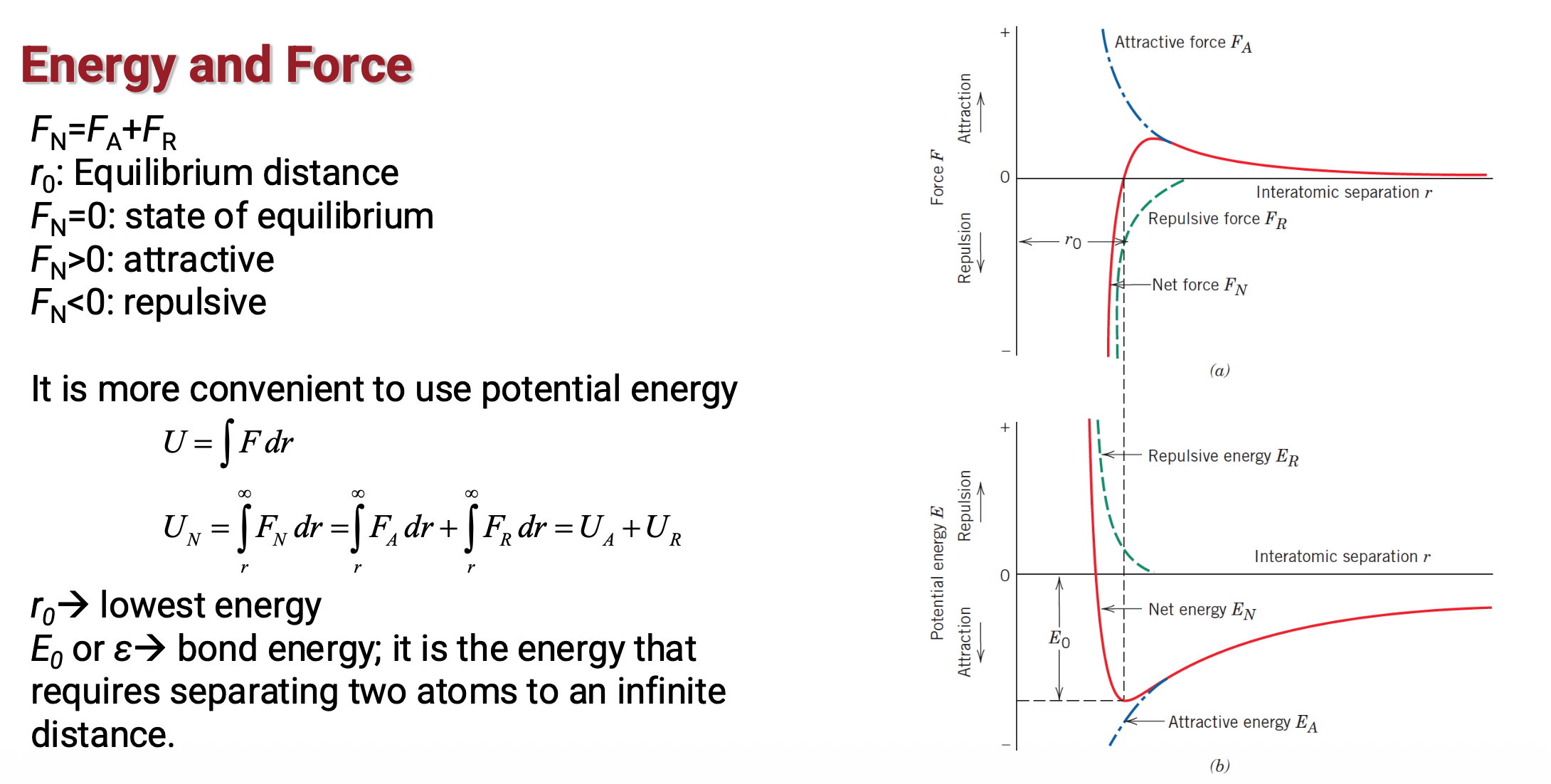
I believe it is the atomic hypothesis (or the atomic fact, or whatever you want to call it) that all things are made out of atoms – little particles that move around, are in perpetual motion, attract each other when they are some distance apart, but repel being squeezed into one another. In that one sentence you’ll see there’s an enormous amount of information about the world if just a little imagination and thinking is applied.
Representing large system with small domain
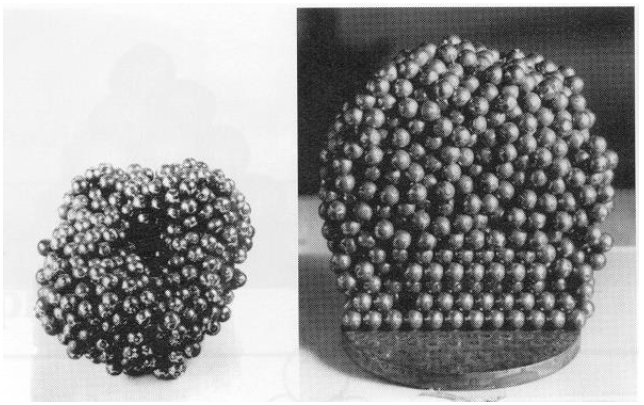
Pioneered by Bernal (UCL) in the 1950s, use ball bearing to study the liquid-solid phase transformation.
Hard-sphere models for materials simulations
Simulating defects with ball bearings!
Another way down the road: molecular dynamics (MD)
Instead of studying the systems in configuration space (\(\{\mathbf{r}_i, \cdot \}\)), MD studies materials in a phase space (\((\{\mathbf{r}_i, \mathbf{p}_i), \cdot \}\)), more naturally representing the Newton’s equation
\[\begin{align} \frac{d \mathbf{r}_i}{dt} &= \frac{\mathbf{p}_i}{m_i} \\ \frac{d \mathbf{p}_i}{dt} &= - \nabla_{r_i} U(\mathbf{r})= \mathbf{F}_i \end{align}\]Time dependency now appears!
MD = energy + dynamics
Energy
- potential energy surface (PES)
- bonding physics
- force evaluation
- material specificity
Dynamics
- Newton’s equations
- time integrator
- thermostat / barostat
- trajectory sampling
- no MD without both parts
- wrong energy or wrong dynamics both lead to wrong physics (butterfly effect)
Dissecting the MD method
Deterministic method: state of the system at any future time can be predicted from its current state (with caution)
MD cycle for one step:
- Force acting on each atom is assumed to be constant during the time interval
- Forces on the atoms are computed and combined with the current positions and velocities to generate new positions and velocities a short time ahead
MD simulations provide a molecular level picture of structure and dynamics → structure-property relationships (SPR)
Timescale in MD
Physical world
- Bond vibrations - 1 fs
- Collective vibrations - 1 ps
- Conformational transitions - ps or longer
- Enzyme catalysis - microsecond/millisecond
- Ligand Binding - micro/millisecond
- Protein Folding - millisecond/second
MD Simulation
- Integration time step - 1 femtosecond
- Set by fastest varying force
- Accessible timescale about 10 nanoseconds
Topic 1: the dynamics
We wanted to talk about the “control” part of the MD
- how do we turn forces into trajectories?
- how do we know the simulation system represents the set ensemble?
- how to get quantities from MD simulation?
A bit of statistical mechanics: averaging quantity in MD
In MD simulation a macroscopic quantity is averaged over time
\[\begin{align} \langle A \rangle_{\text{time}} = \frac{1}{\tau}\int_0^\tau A(t)\,dt \end{align}\]The ergodic assumption gives that for an infinitely long enough simulation, every configuration in the phase space should eventually be visited. (Like MC, but we evolve continuously in time)
\[\begin{align} \langle A \rangle_{\text{ens}} = \int d\mathbf r^N d\mathbf p^N \, A(\mathbf r^N,\mathbf p^N)\,\rho(\mathbf r^N,\mathbf p^N) \end{align}\]Time average = Ensemble average
What quantities are we interested in MD?
What quantities are we interested in MD?
Thermodynamic
- temperature \(T\)
- pressure \(P\)
- energy \(E\)
Structural
- radial distribution function \(g(r)\)
- coordination number \(N_c\)
- defect structure / order parameter \(c_i(\mathbf r)\)
Kinetic
- diffusivity \(D\)
- viscosity \(\eta\)
- relaxation time \(\tau\)
- conductivity \(\mu\)
Ensembles: how to describe your system?
In a MD setup, we usually want to fix a few macroscopic quantities while let others to give our statistical average
Relate to thermodynamic relations
\[ dU = T\,dS - P\,dV + \mu\,dN \]
common MD ensembles:
- NVE (micro-canonical)
- NVT (canonical)
- NPT (isothermal- isobaric)
Comparison between ensembles
NVE
- isolated system
- fixed \(N,V,E\)
- Probability \(\rho_{NVE} \propto \delta(H-E)\)
NVT
- heat bath
- fixed \(N,V,T\)
- \(\rho_{NVT} \propto e^{-H/k_B T}\)
NPT
- heat + pressure bath
- fixed \(N,P,T\)
- \(\rho_{NPT} \propto e^{-(H+PV)/k_B T}\)
MD: how to advance in time?
Just solve the coupled dynamic equations
\[\begin{align} \dot{\mathbf r}_i &= \mathbf v_i \\ m_i \dot{\mathbf v}_i &= \mathbf F_i \end{align}\]At each time step:
- compute forces
- update positions and velocities
- apply ensemble control if needed
- collect observables
The Verlet algorithm
We can of course use \(t \to t + \Delta t\) (the forward Euler) method, but maybe not so stable.
Verlet algorithm: use Taylor expansion
\[\begin{align} \mathbf r_i(t+\Delta t) = 2\mathbf r_i(t)-\mathbf r_i(t-\Delta t) +\mathbf a_i(t)\Delta t^2 + O(\Delta t^4) \end{align}\]Requires 2 time steps to advance
\[\begin{align} \mathbf v_i(t) = \frac{\mathbf r_i(t+\Delta t)-\mathbf r_i(t-\Delta t)}{2\Delta t} \end{align}\]Can now go back in time!
Velocity Verlet: most common practical form
\[\begin{align} \mathbf r_i(t+\Delta t) &= \mathbf r_i(t)+\mathbf v_i(t)\Delta t+\frac{1}{2}\mathbf a_i(t)\Delta t^2 \\ \mathbf v_i\!\left(t+\frac{\Delta t}{2}\right) &= \mathbf v_i(t)+\frac{1}{2}\mathbf a_i(t)\Delta t \\ \mathbf a_i(t+\Delta t) &= \frac{\mathbf F_i(t+\Delta t)}{m_i} \\ \mathbf v_i(t+\Delta t) &= \mathbf v_i\!\left(t+\frac{\Delta t}{2}\right)+\frac{1}{2}\mathbf a_i(t+\Delta t)\Delta t \end{align}\]MD: choice timestep
\(\Delta t\) must resolve the fastest motion
too large:
- unstable integration
- broken energy conservation
too small:
- too expensive
MD: typical values for timesteps
- metal MD: \(\sim 1\) fs
- molecules with constrained bonds: \(\sim 2\) fs
- coarse motion / rigid modes: up to \(\sim 10\) fs
- ab initio MD: often smaller than 1 fs
MD: how to maintain ensemble?
- NVE: integrate Newton’s law only
- NVT: add thermostat
- NPT: thermostat + barostat
Ideas for thermo- and barostats:
- thermostat controls kinetic energy
- barostat allows box size / shape to fluctuate
Comparison between thermostats
Berendsen
- fast equilibration
- weakly rescales velocities
- does not generate exact canonical ensemble
Nosé-Hoover
- extended dynamical system
- samples canonical ensemble better
- may oscillate if poorly tuned
Langevin
- friction + random force
- good temperature control
- can distort dynamics if damping is too strong
Topic 2: the energy
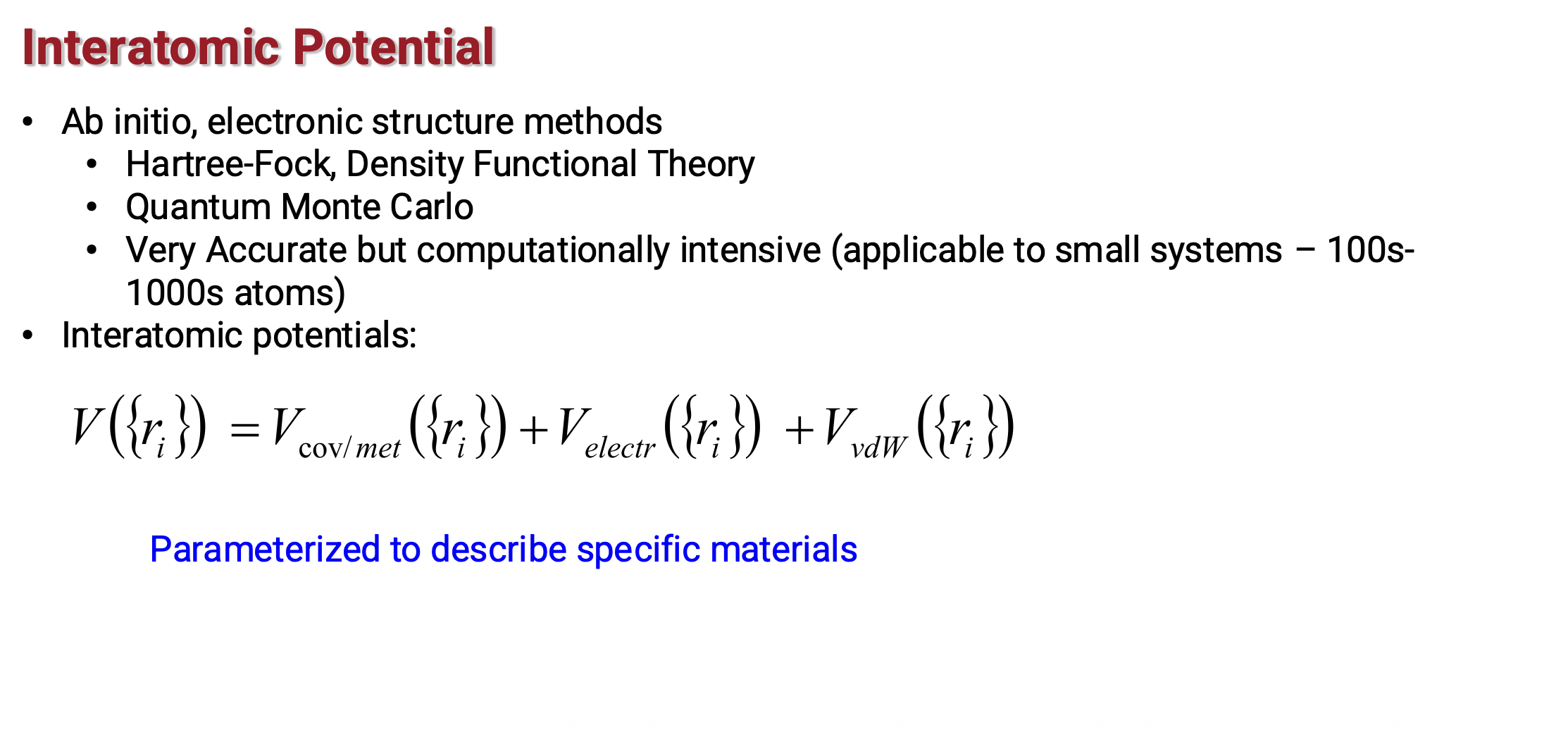
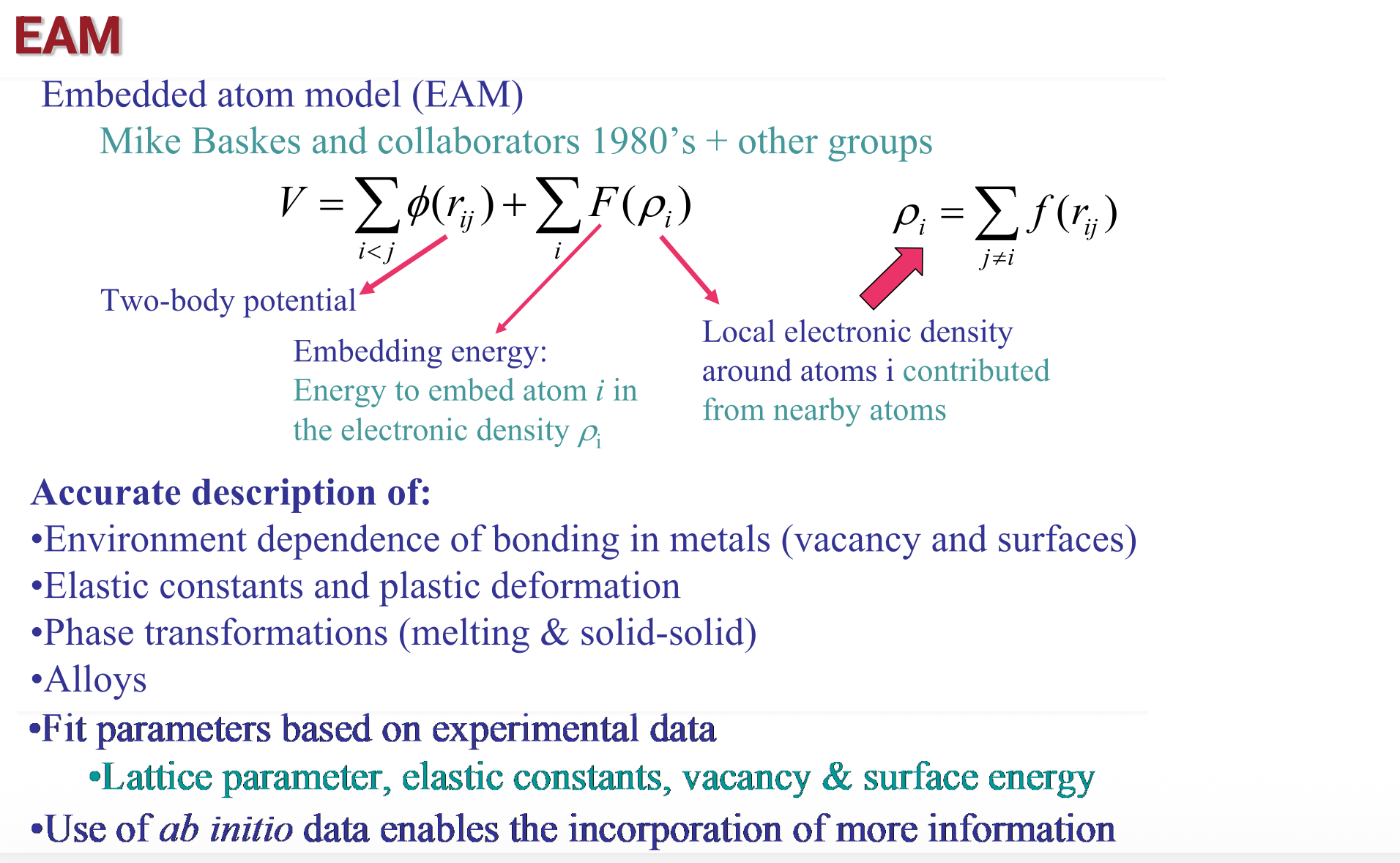
- How do you get the energy and forces?
- Which energy form is good?
- Can we get energy from data?
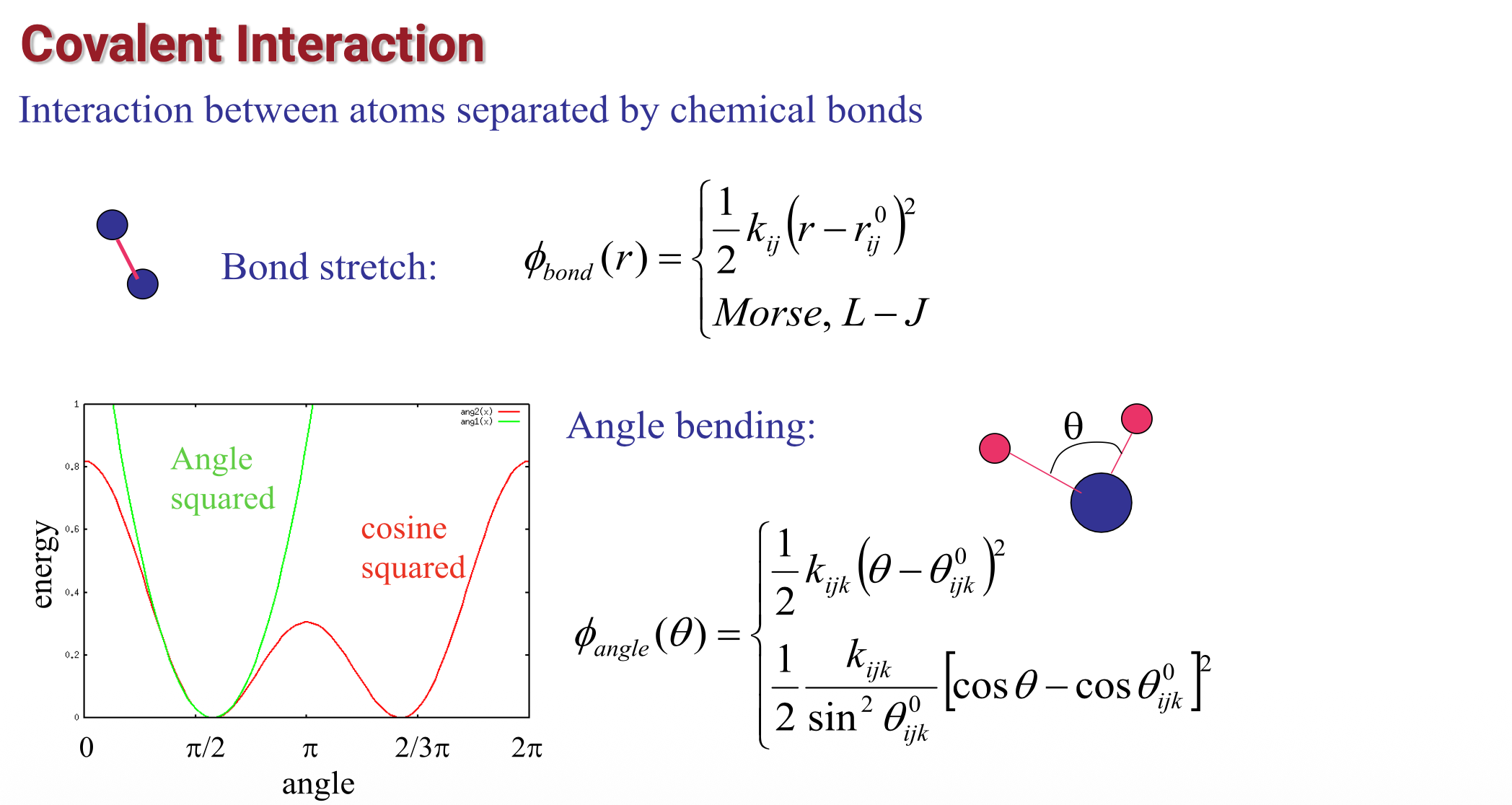
Potential energy in MD (1)
Potential energy in MD (2)
Potential energy in MD (3)
Potential energy in MD (4)
More about the atomic hypothesis
Still from Feynman:
If, in some cataclysm, all of scientific knowledge were to be destroyed, and only one sentence passed onto the next generations of creatures, what sentence would contain the most information in the fewest words? I believe it is the atomic hypothesis that all things are made of atoms – little particles that move around in perpetual motion, attracting each other when they are a little distance apart, but repelling upon squeezed into one another. In that sentence, you will see, there is enormous amount of information about the world, if just a little imagination and thinking are applied
Example of data-driven potential
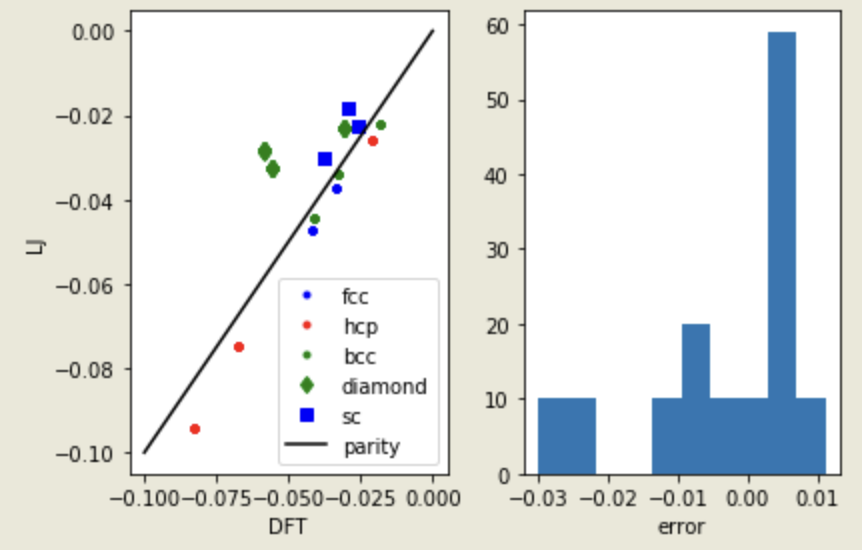
Can we use data to train potential? Examples from John Kitchin (CMU)
- Atomic Simulation Environment (ASE) as a easy python wrapper over the atomistic calculator
- Bulk argon energies calculated in different lattice type, volume etc.
- Fit the polynomial LJ potential using the DFT dataset!
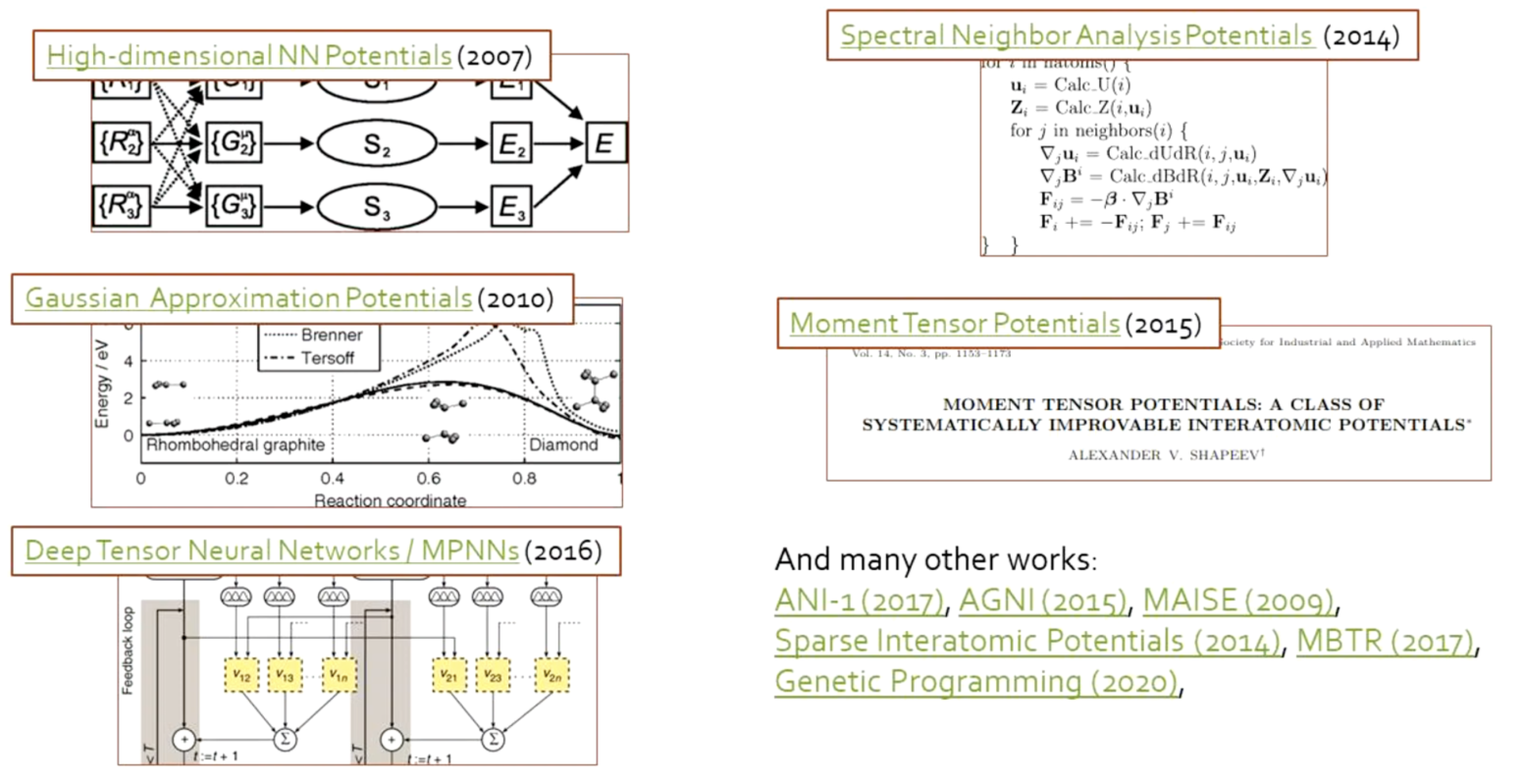
Interatomic potentials: from polynomials to machine learning
Summary
- Molecular dynamics evolves atomic positions and momenta using Newton’s equations
- MD simulations require interatomic forces, numerical integration, and ensemble control
- The choice of potential strongly affects what material behavior an MD model can represent