MATE 664 Lecture 01
Thermodynamics and Kinetics
2026-01-05
Textbook and references
Our primary textbooks for this course are:
- Kinetics of Materials by R.W. Balluffi, S.M. Allen, and W.C. Carter.
- Materials Kinetics: Transport and Rate Phenomena by John C. Mauro.
What will we learn in MAT E 664 (1)?
Theory: irreversible thermodynamics & driving forces
\[ \text{Flux} = \text{Kinetic coefficients} \times \text{Driving Force} \]
What will we learn in MAT E 664 (2)?
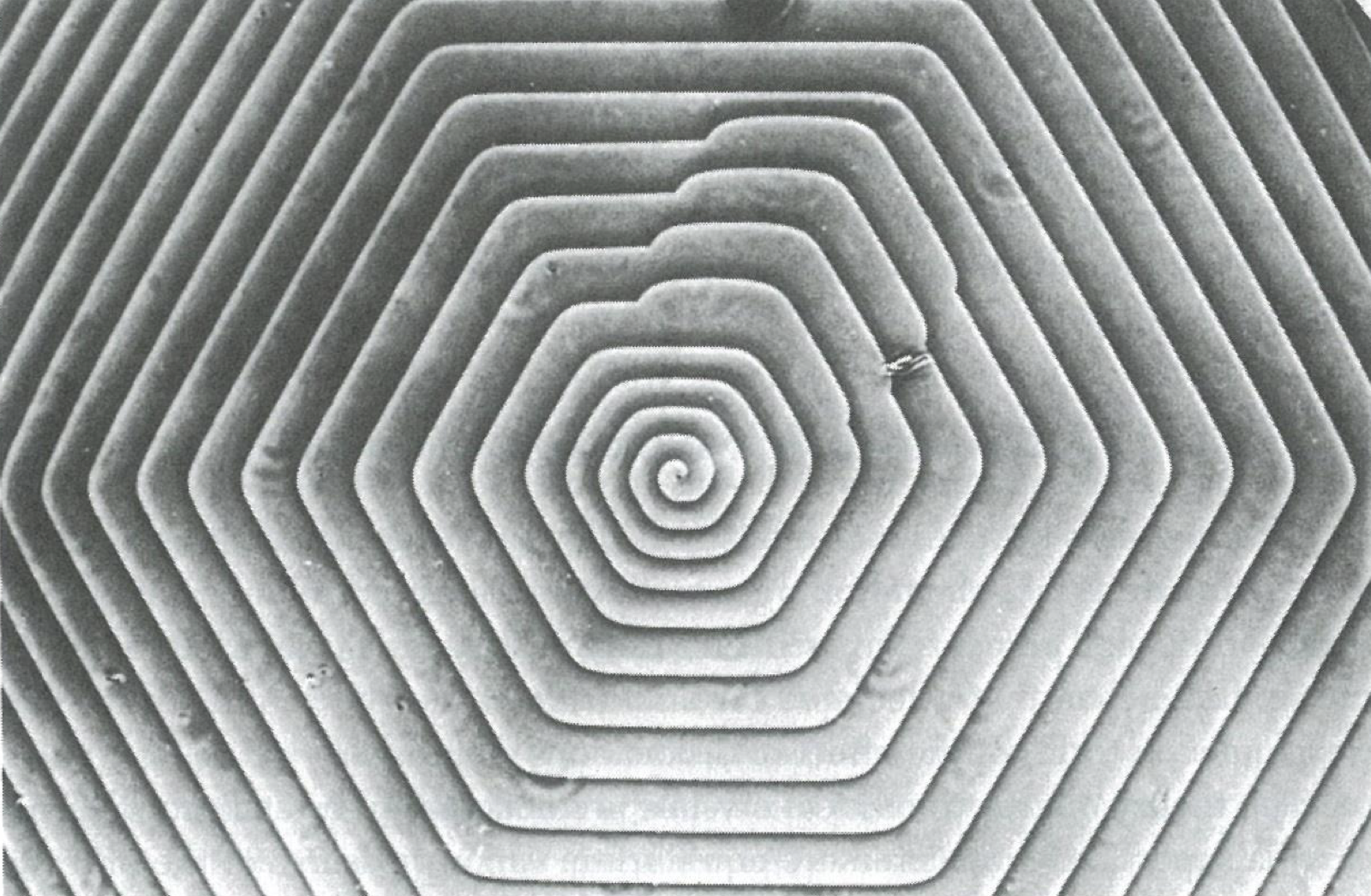
Mass transport on solid material interfaces: \(v_{step} = \beta (c - c_{eq})\)
1
## What Will We Learn in MAT E 664 (3)?
Nucleation theory: \(r_{c} = -\dfrac{2\gamma}{\Delta G_v}\)

1
What will we learn in MAT E 664 (4)?
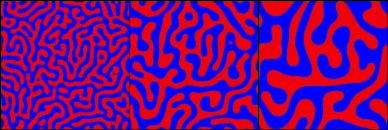
Spinodal Decomposition (Pattern Formation) \[ \dfrac{\partial c}{\partial t} = \nabla \cdot \left( M \nabla \left[ \dfrac{\partial f(c)}{\partial c} - \kappa \nabla^{2} c \right] \right) \]
1
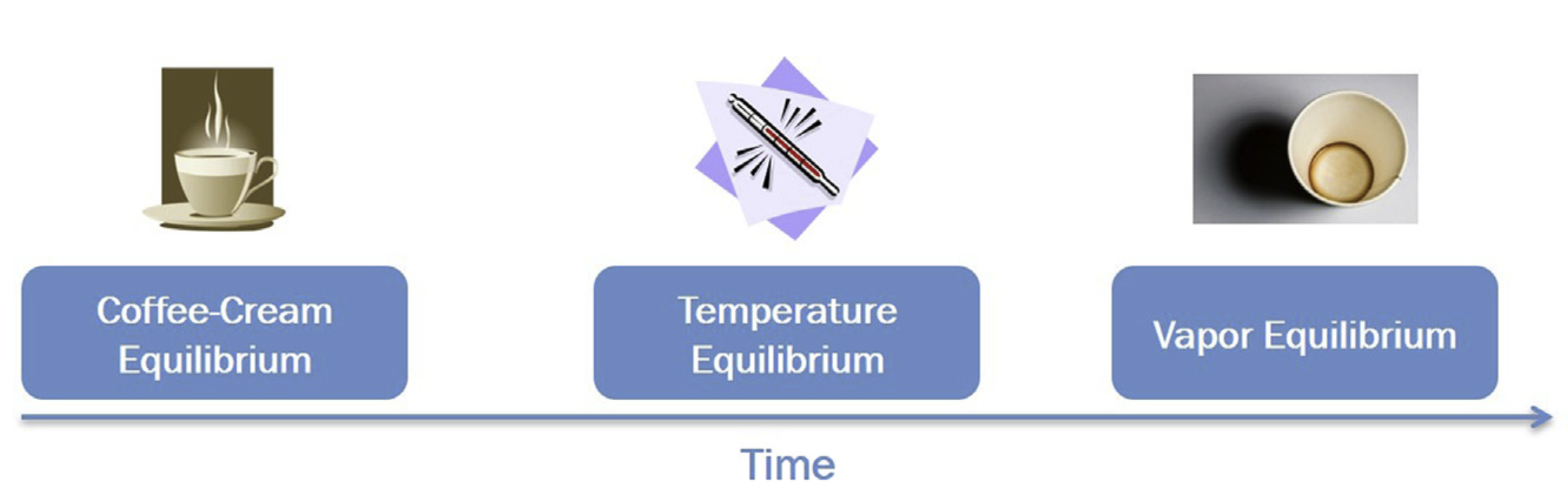
The true meaning of equilibrium
Equilibrium is a balance of time scales: \[ \tau_{\text{observation}} \gg \tau_{\text{process}} \]
- Thermodynamic descriptions are relevant when the observation time scale is much larger than the time scale of the processes reaching equilibrium.
- It’s about specific processes reaching a steady state, not necessarily the entire system.
1
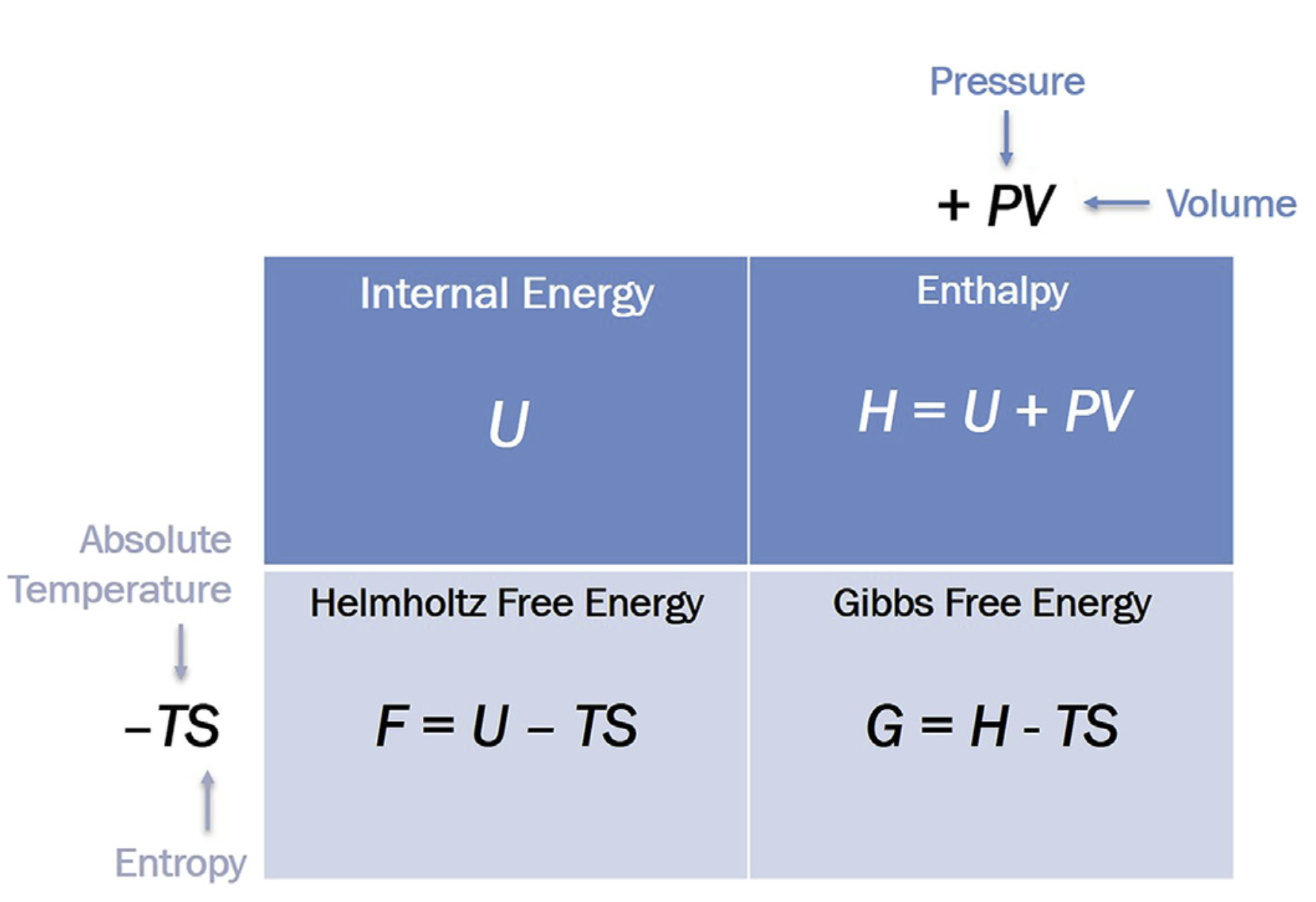
Classical thermodynamics revisited
1
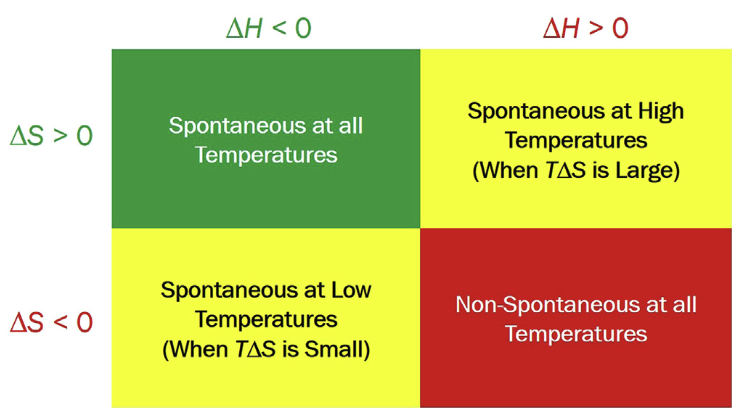
Thermodynamic interplay between \(H\) and \(S\)
Whether a process from A → B is spontaneous or non-spontaneous depends on the sign of free energy difference, \(\Delta G = G_{B} - G_{A}\).
1
- What is \(\Delta G\) for a reversible process at equilibrium?: \(\Delta G = 0\),
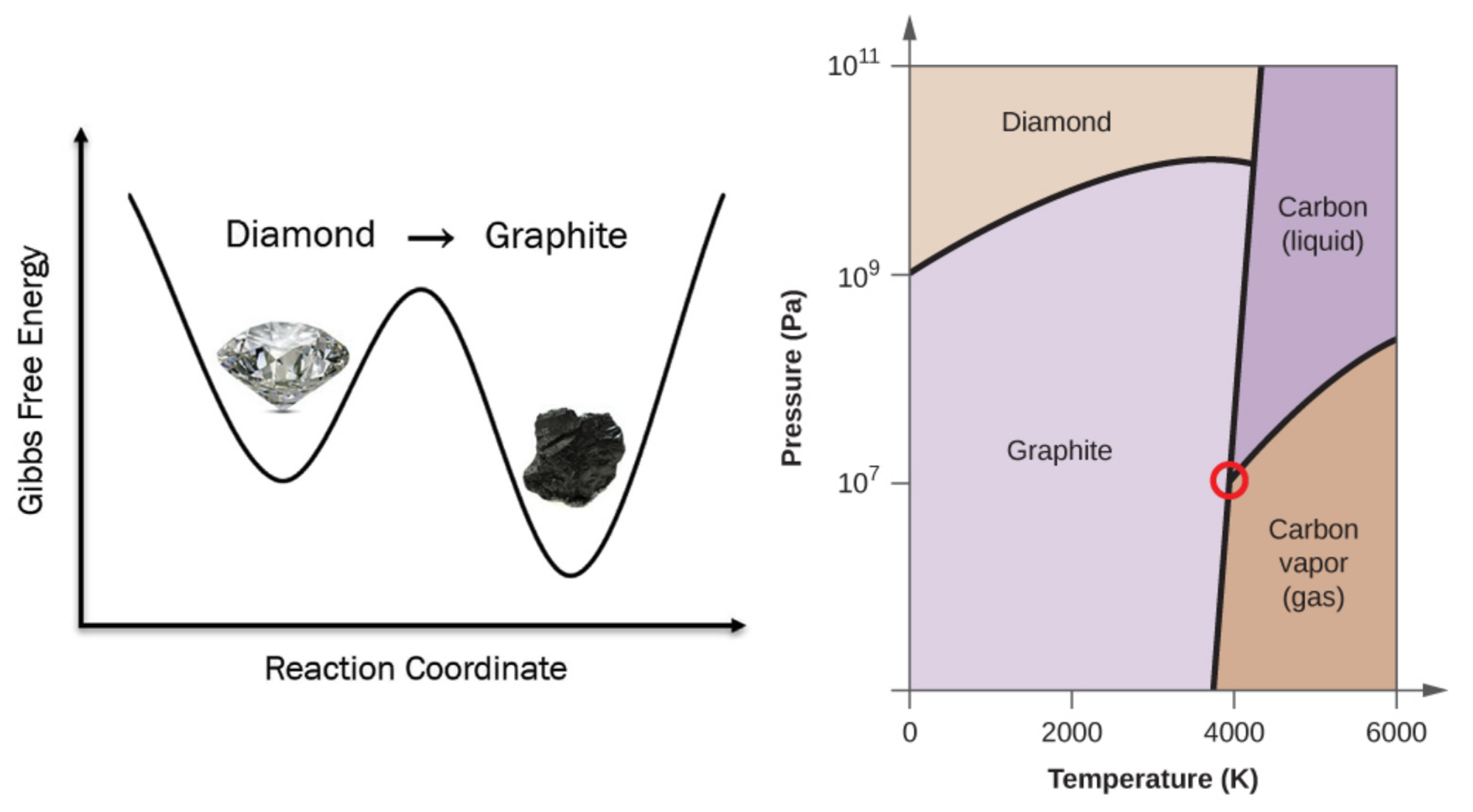
- How can we check the stability of a certain material at \(P, T\)?: Use the phase diagram!
How stable is diamond?
- Which phase is the most stable at r.t. & 1 atm?
- Should we worry our diamond rings turn into pencil?
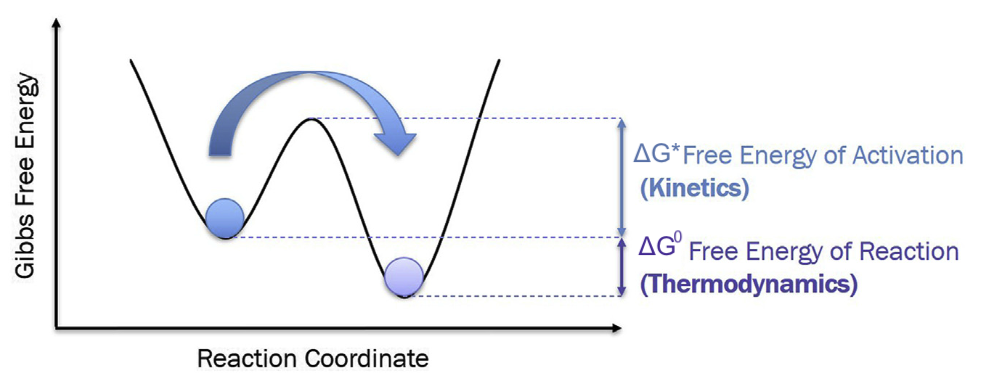
Two-state model of thermodynamics vs kinetics
- \(\Delta G^0\): Free energy of reaction → will reaction happen? (Thermodynamics)
- \(\Delta G^*\): Free energy of activation → how likely / fast? (Kinetics)
Where does entropy \(S\) come from?
- Claussius (1865) Classical thermodynamics.
- Entropy is a state variable of internal energy.
- \(dU(S, V) = TdS - pdV\)
- Boltzmann (1877) Statistical mechanics.
- Entropy is a measure of accessible microstates (atoms + probability!)
- \(S = k_B \log(\Omega)\)

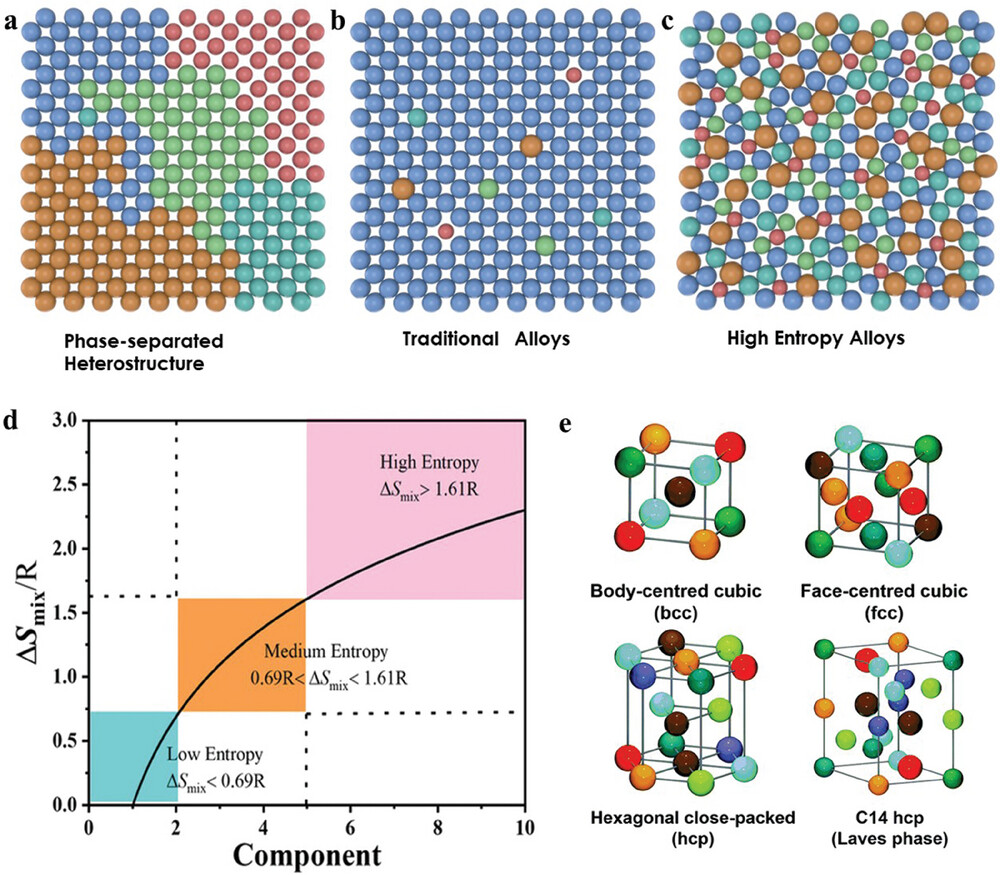
Entropy IS NOT Disorder!
- Common statement of entropy is measure of disorder
- Boltzmann equation measures how many possibilities of arrangement
- Disorder is not uniquely linked to number of microstates!

Entropy IS NOT Disorder – II!
- High entropy alloys (HEAs): Example of high configurational entropy material
- Many HEAs have much more ordered lattice than binary alloys
1
Brief introduction to course AI helper
- A Socratic Gemini chatbot aiming to help course learning and key concepts
- Access the AI helper here: 👉 https://gemini.google.com/gem/1c118102b2d1