Estimating diffusivity: example 1
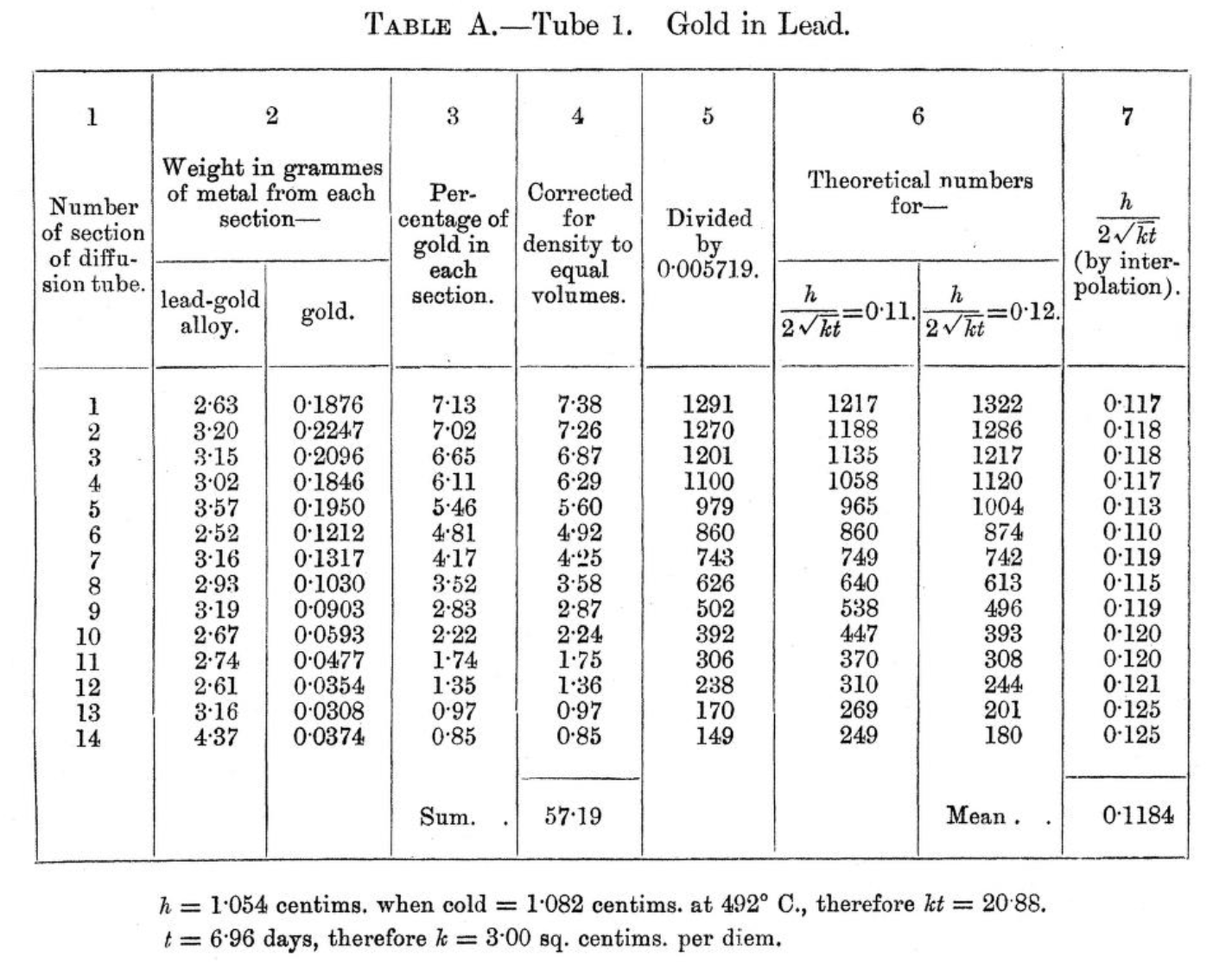
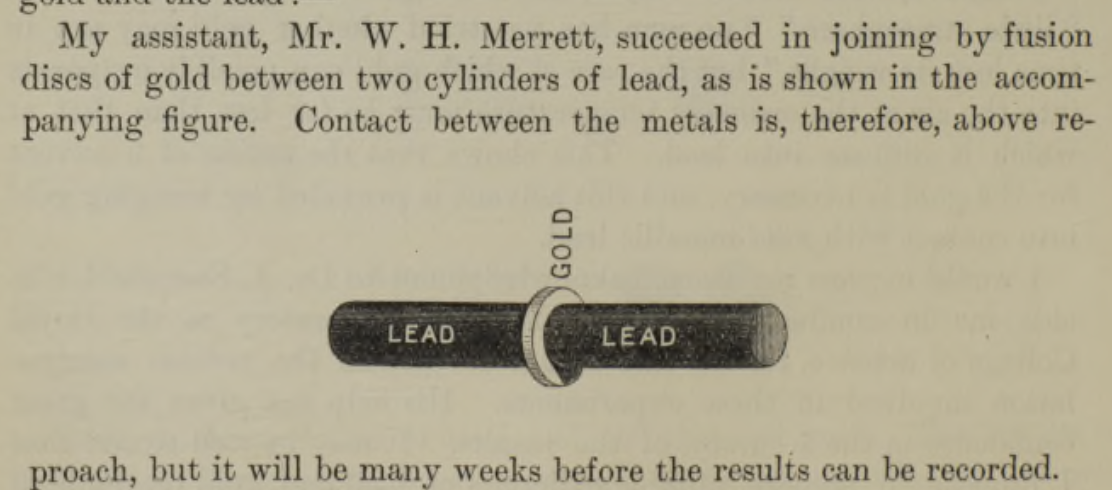
The first diffusivity in metal was presented in 1894 by Roberts-Austen using diffusion of Au in liquid Pb. (See review by Mehrer and Stolwijk, Diffusion Fundamentals, 2008, 1, 1-32).
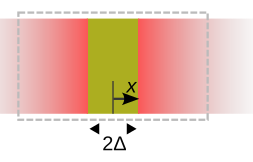
The experiment is basically a solid Au-Pd alloy cylinder diffusing into semi-infinite molten Pd at \(T\)=492 ℃, as the geometry below. Experiment weight fraction of Au was determined by precision scales on sections of cylinder after \(t=6.96\) days. Can we verify his results of diffusivity (\(\tilde{D}=3.00\) cm\(^2\)d\(^{-1}\))?
![]()
Introduction to Atomic Models of Diffusion
Motivation: predicting \(D\) from atomistic simulations
- We know from experiments how to extract the \(D\) (or \(\tilde{D}\)) very well
- But how are the diffusivities coming from atomic models?
- Can we predict \(D\) from some calculations?
Diffusion: bridging atomic and macroscopic pictures
Two major achievements in 20th century
- Explanation of Brownian motion (Einstein)
- macroscopic diffusion emerges from random atomic motion
- link between mean-square displacement and diffusivity
- Atomic interpretation of Fick’s laws
- diffusion coefficient related to jump frequency and jump distance
- connects lattice-scale mechanisms to continuum transport equations
Mean squared displacement (Brownian motion picture)
A particle undergoes a sequence of thermally activated jumps
- jump displacement for \(k\)-th step: \(\vec{r}_k\)
- after \(N_s\) jumps, total displacement:
\[
\vec{R}(N_s) = \sum_{k=1}^{N_s} \vec{r}_k
\]
- What is the mean displacement \(\langle R \rangle\)? (it’s zero!)
Mean squared displacement (MSD):
\[
\langle R^2(N_s) \rangle = \left\langle \vec{R}(N_s)\cdot \vec{R}(N_s) \right\rangle
\]
MSD: expansion and randomness assumption
Expand the dot product:
\[
R^2(N_s)
=
\sum_{k=1}^{N_s} |\vec{r}_k|^2
+
2\sum_{k=1}^{N_s-1}\sum_{m=k+1}^{N_s} \vec{r}_k \cdot \vec{r}_m
\]
If successive jumps are uncorrelated (random directions):
\[
\langle \vec{r}_k \cdot \vec{r}_m \rangle = 0 \quad (k\neq m)
\]
Then
\[
\langle R^2(N_s) \rangle
=
N_s \langle r^2 \rangle
\]
where \(\langle r^2 \rangle\) is the mean squared jump distance.
Random jump MSD from continuum diffusion
Consider diffusion from a point source in 3D into infinite space. The concentration at each \(r\) at any time \(t\) is \(c(r, t)\)
Define MSD as the normalized second moment of \(c(r, t)\)
\[
\langle R^2(t)\rangle
=
\frac{\int_0^\infty r^2\,c(r,t)\,4\pi r^2\,dr}{\int_0^\infty c(r,t)\,4\pi r^2\,dr}
\]
Luckily, the solution to \(c(r, t)\) was already known in 1905 as Gaussian (also from last lecture):
\[
c(r, t) = \frac{N}{{\sqrt{4 \pi Dt}}^3}
\exp\!(-\frac{r^2}{4Dt}),\qquad r^2 = x^2 + y^2 + z^2
\]
Einstein diffusion equation from continuum diffusion
Use the Gaussian form, Einstein showed for 3D random jump, we have
\[
\langle R^2(t)\rangle = 6Dt
\]
More generally in \(d\) dimensions:
\[
\langle R^2(t)\rangle = 2d\,Dt
\]
- This is known as Einstein diffusion equation
- Links atomic motion (Brownian motion, \(<R^2>\)) to continuum diffusion (\(D\))
Diffusion from random walk model
1D random walk with step \(\pm 1\) (site index \(n\))
Constraints after \(N_\tau\) steps:
\[
N_R - N_L = n,\quad N_R + N_L = N_\tau
\]
Number of ways (binomial):
\[
U(n,N_\tau)=\frac{N_\tau!}{N_R!N_L!}
\]
For an unbiased walk \(p_L=p_R=1/2\):
\[
p(n,N_\tau)
=
\frac{N_\tau!}{N_R!N_L!}\left(\frac12\right)^{N_\tau}
\]
Large-step limit gives Gaussian form:
\[
p(n,N_\tau)\propto \exp\!\left(-\frac{n^2}{2N_\tau}\right)
\]
Linking random walk to macroscopic \(D\)
Identify:
- diffusion distance: \(x \sim n\,\Delta x\)
- number of steps: \(N_\tau \sim \Gamma t\) (jump frequency \(\Gamma\))
From MSD (1D):
\[
\langle x^2(t)\rangle
=
\langle n^2\rangle (\Delta x)^2
\sim N_\tau (\Delta x)^2
\sim \Gamma t (\Delta x)^2
\]
Compare with Einstein (1D): \(\langle x^2(t)\rangle = 2Dt\)
\[
D = \frac{\Gamma (\Delta x)^2}{2}
\qquad
\text{(in 1D)}
\]
General \(d\)-D form:
\[
D = \frac{\Gamma \langle r^2\rangle}{2d}
\]
Summary
- Numerical solutions to diffusion equations
- Applying numerical fitting for \(D\)
- Introducing to atomic picture of diffusivity
Next steps
- Understanding the atomic model in liquid and lattices
- Complex mechanism of lattice diffusion
- Estimating \(D\) from thermodynamic data