mindmap
  root((Mass Transfer))
    Mass Balance
      Steady State
      Unsteady State
        Boundary conditions
        Reaction rate coupling
      Pseudo-steady State

    Flux Equation
      Diffusion
        Fick 1st law
        Diffusive velocity
      Convection
        Convective velocity

    General Systems
      EMCD
      Stagnant B
      General and reaction

    Geometry
      1D slab
      Cylinder
      Sphere
      Varying cross section

    State of Material and Diffusivity
      Gas
        Chapman–Enskog
        Fuller
      Liquid
        Stokes–Einstein
      Solid
        Solubility
        Permeability
        Effective diffusivity
CHE 318 Lecture 12
Preparation Before Midterm / Convective Mass Transfer
Note
- Slides 👉 Open presentation🗒️
- PDF version of course note 👉 Open in pdf
- Handwritten notes 👉 Open in pdf
Recap
- Several example systems in unsteady state mass transfer regime
- General procedures to identify generation / accumulation terms
- Steady state solution from mass balance equations
Learning outcomes
After this lecture, you will be able to:
- Recall key ideas from steady-state and unsteady-state mass transfer.
- Describe representative midterm-style solution steps.
- Identify common conceptual pitfalls in mass transfer problems.
- Relate convective mass transfer ideas to earlier diffusion topics.
Midterm exam announcement
- Date: Feb 09, 2026 (Monday)
- Time: 50 min during class
- Question types:
- Multiple-choice questions (conceptual, no derivation)
- Short-answer questions (conceptual, no derivation)
- Long-answer questions (derivation and / or calculation)
- Formula sheet / calculator policy: refer to course syllabus
Midterm exam questions
- Covers up to unsteady state mass transport
- Sample questions to be released this week on Canvas
- Use our AI helper wisely!
Key concepts of mass transfer
- Q: What is mass transfer about?
- Moving of chemical species through space
- Q: What does mass transfer study?
- How fast can we move chemicals / materials through space –> Concept of flux
- What drives species to move? –> Concept of driving force / concentration gradient
- Resistance of species moving during transport –> Concept of Diffusivity
- Slow vs fast ways to move species –> diffusion vs convection
- Q: What systems do we study?
- Steady state: concentration of species do not change over time
- Unsteady state: concentration of species change over time
A mind map for mass transfer part I
Sample Questions (2019)
- Please check our Canvas examples for solutions.
- We will give a few “what do we look for” and “potential pitfalls”
- Always remember to draw the diagram and list conditions!
Short answer question
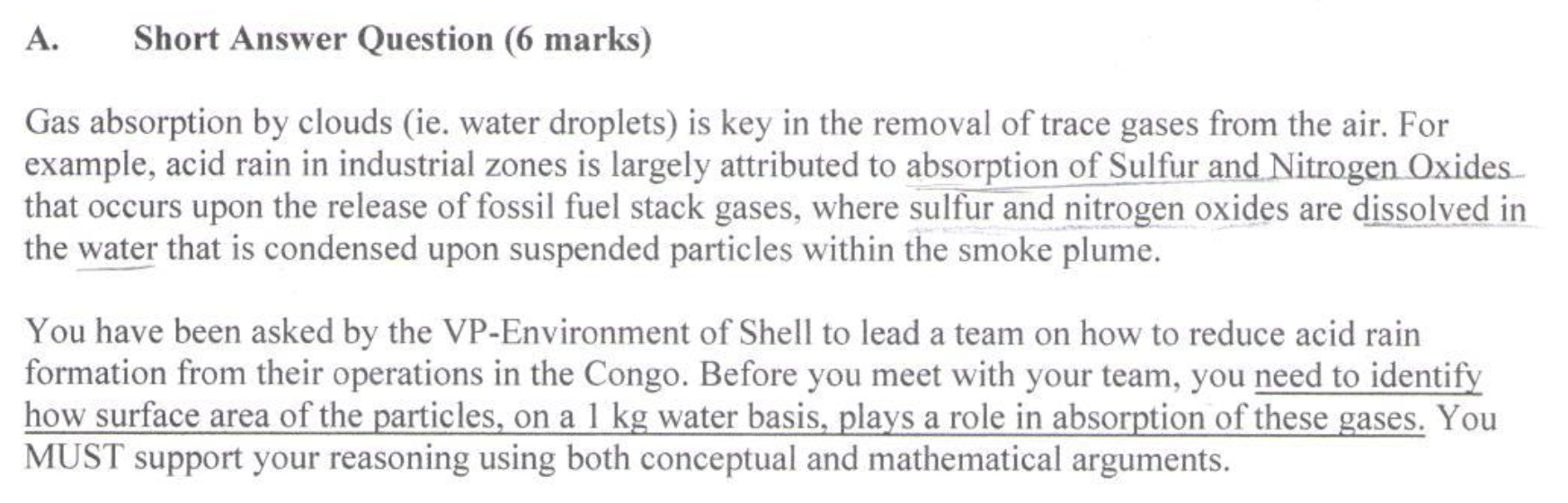
Short answer question 1 – key points
- Surface area of droplet – sphere – \(4 \pi r_0^2\)
- Total flux per droplet – \(\overline{N}_A = 4 \pi r_0^2 N_A\) (bonus: the flux is described by stagnant B solution)
- Relation between surface flux \(N_A \propto r_0^{-1}\)
- Number of droplets \(n \propto r_0^{-3}\)
- Total mass transfer for same weight: \(\propto r_0^{-2}\)
Conclusion: - smaller particle \(r_0\) 👉 larger combined area 👉 larger total flux / amount of absorption - (bonus) in practice you want to balance between making smaller droplets, and energy cost for producing the droplets
Long answer question 1

Long answer question 1 – key points
- Sign in \(N_A\) or \(J_{Az}^*\)
- EMCD situation
- Use Fuller method to calibrate \(D_{AB}\) (\(\propto T^{1.5}/P\))
Long answer question 2
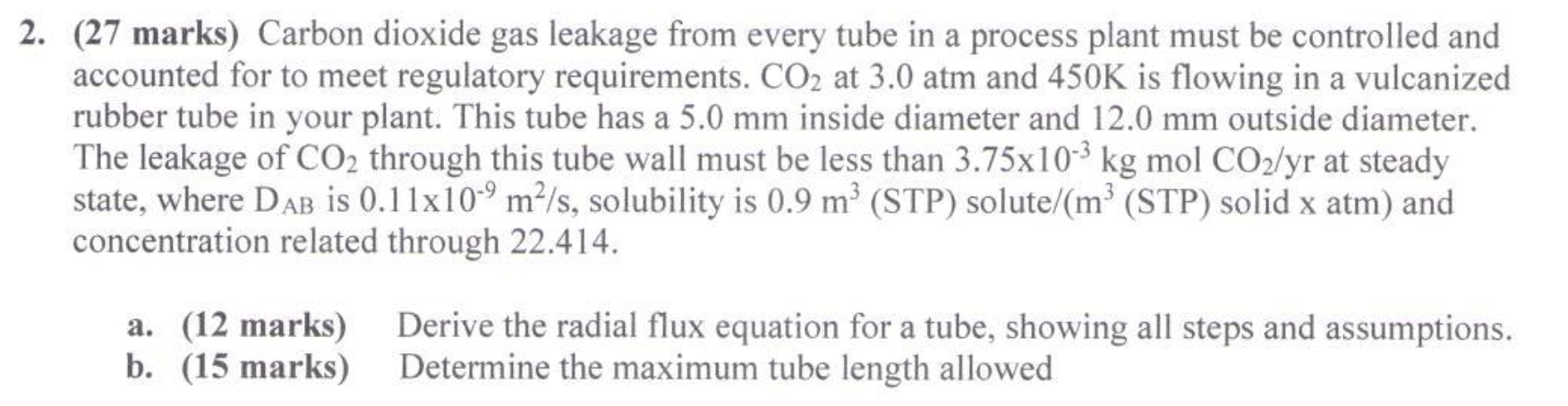
Long answer question 2 – key points
- Diagram (a cylinder with in/out diameter & length)
- Solid diffusion 👉 EMCD-like equation (diffusion only)
- DO NOT write \(N_A \propto 1/(d_2 - d_1)\)!
- Steady state flux eq. in cylindrical coordinate
- Governing eq for cylindrical coordinate
- Use of \(\overline{N}_A\) for steady state
- \(c_A\) from solubility
Long answer question 3
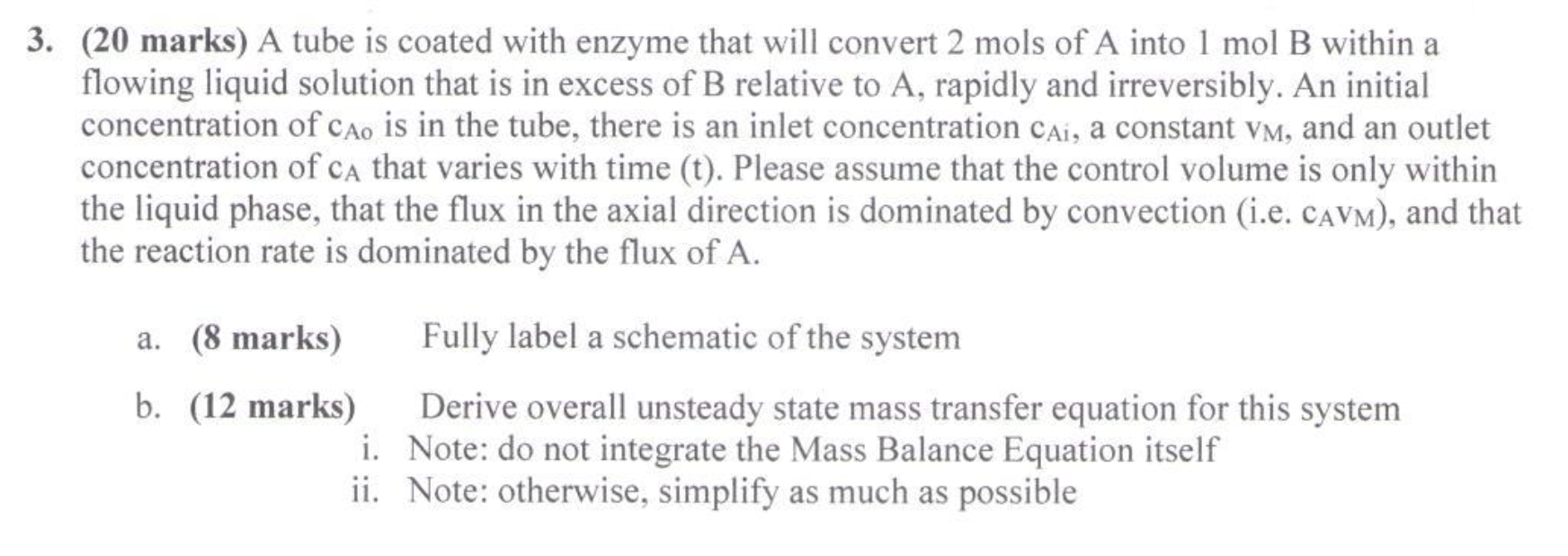
Long answer question 3 – key points
- Diagram (convection in axial / z-axis; diffusion in radial / r-axis)
- Mass balance in control volume
- Generation term link to flux-controlled consumption
- Flux boundary conditions in r-axis
Summary
- Good luck with the midterm exam!