CHE 318 Lecture 18
Dimensionless Numbers In Mass Transfer
Note
- Slides 👉 Open presentation🗒️
- PDF version of course note 👉 Open in pdf
- Handwritten notes 👉 Open in pdf
Recitation: What Have Learned So Far?
Note
Please use the bullet points in this recitation to review the previous topics.
Topic 1: steady-state mass transfer
Governing equation
Geometry
Applications
Topic 2: unsteady-state mass transfer
Governing equation
Geometry
Applications
Topic 3: convective mass transfer (mass-transfer coefficient)
Governing equation
Geometry
Applications
Learning outcomes
After this lecture, you will be able to:
- Recall key governing equations from steady, unsteady, and convective mass transfer.
- Describe the roles of Reynolds, Schmidt, and Sherwood numbers in coefficient correlations.
- Identify how \(k_c'\), concentration, and flux are linked in convective mass transfer problems.
Dimensionless number 1: \(N_{Re}\)
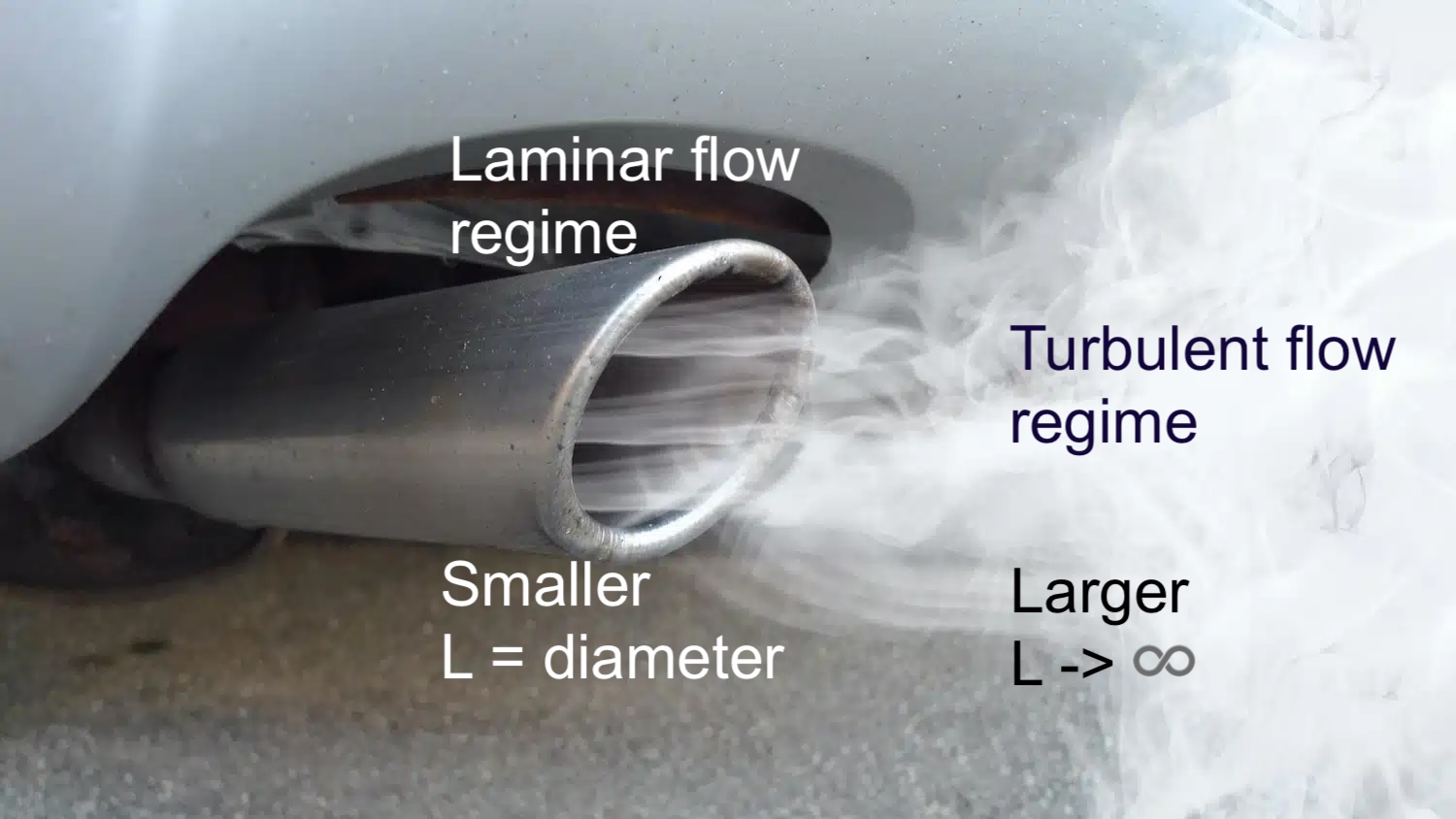
- Reynolds number measures ratio between kinetic vs viscous forces of fluid flow
- \(L_D\): characteristic length of system
Meaning of \(N_{Re}\)
- \(N_{Re}\): laminar flow vs turbulent flow
- Varies with characteristic length \(L_D\) (diameter for a pipe)
Dimensionless number 2: \(N_{Sc}\)
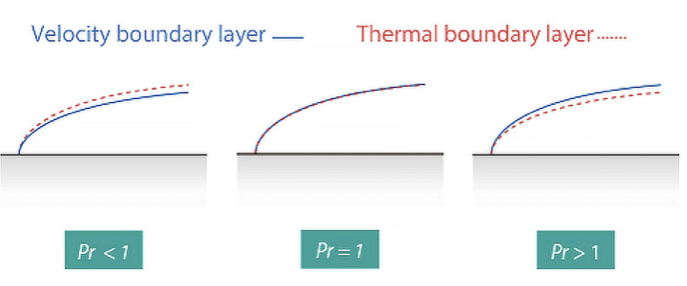
- Schmidt number: ratio between momentum diffusivity and molecular diffusivity
- Related to ratio of hydrodynamic layer and mass transfer layer thickness
Meaning of \(N_{Sc}\)
- \(N_{Sc}\): fluid boundary layer thicker or mass transfer thicker?
- Similar to Prandt number in heat transfer
- \(N_{Sc}^{1/3} = \dfrac{\delta}{\delta_c}\)
Dimensionless number 3: \(N_{Sh}\)
- Sherwood number: ratio between convective mass transfer and molecular mass transfer
- Has \(k_c'\) inside! –> Usually a back-calculated number
General procedure to calculate \(k_c'\)
- Dimensionless numbers solely from geometry and property: \(N_{Re}\), \(N_{Sc}\)
- Dimensionless number having \(k_c'\): \(N_{Sh}\)
- Link between them: \(j_D\)
- How to obtain \(j_D\)?
- Expression for different geometry / fluid flow
- Use Table / Chart
Summary
- Overview of dimensionless numbers to correlate mass transfer coefficients
- Dimensionless numbers: grouping different regimes
- Use table / charts to correct \(k_c\) (will discuss in Lecture 19)