CO2 system: x_1 = 1.406e-04, y_2= 0.200
SO2 system: x_1 = 1.592e-02, y_2= 0.159CHE 318 Lecture 23
Mass Transfer In Two-Phase Column: Operating Line
Note
- Slides 👉 Open presentation🗒️
- PDF version of course note 👉 Open in pdf
- Handwritten notes 👉 Open in pdf
Learning outcomes
After this lecture, you will be able to:
- Recall the overall mass-balance framework for two-phase absorption systems.
- Identify the operating line on an equilibrium diagram.
- Apply equations to calculate outlet composition and minimum flow rate for an absorption tower.
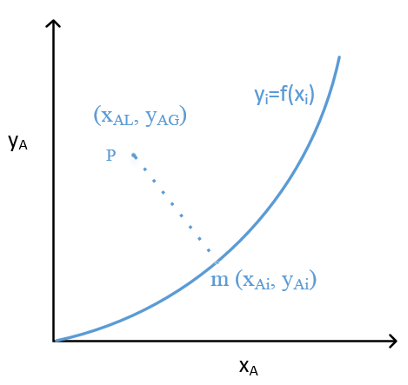
Recall: reading an equilibrium diagram
Key features:
- x-axis & y-axis meaning?
- Points on the eq. curve?
- Points above and below eq. curve?
- How to get interfacial composition?
- Slope of line to interfacial points?
Local overall mass transfer coefficients
- Knowing \(k_x\) and \(k_y\) (film coefficients) allows us to calculate the interfacial concentration \((x_{Ai}, y_{Ai})\)
- However, in many industrial applications exact \(k_x\) and \(k_y\) are hard to find
- Use of overall mass transfer coefficients
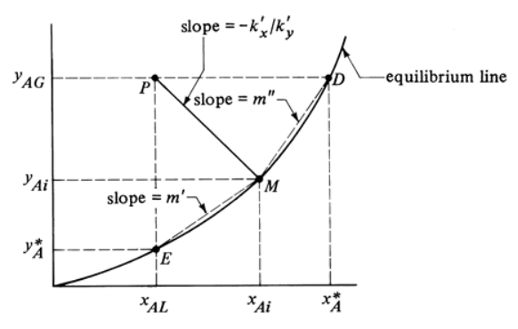
Relation between overall and exact mass transfer coefficients
- Exact coefficient \(k_x\), \(k_y\): driving force \(y_{AG} - y_{Ai}\)
\[ N_A = k_y(y_{AG} - y_{Ai}) \]
- Overall coefficient \(K_x\), \(K_y\): driving force \(y_{AG}-y_A^*\)
\[ N_A = K_y (y_{AG} - y_A^*) = K_x (x_A^* - x_{AL}) \]
\(K_x\) and \(K_y\) on a diagram
- What are the driving forces associated with \(K_x\) and \(K_y\)?
\((x, y)\) relation in a reactor
- Consider an absorption tower with gas inlet at \(y_{A1}\) and outlet at \(y_{A2}\)
- The gas solute is continuously absorbed by the flowing water phase
- Which is larger, \(y_{A1}\) or \(y_{A2}\)?
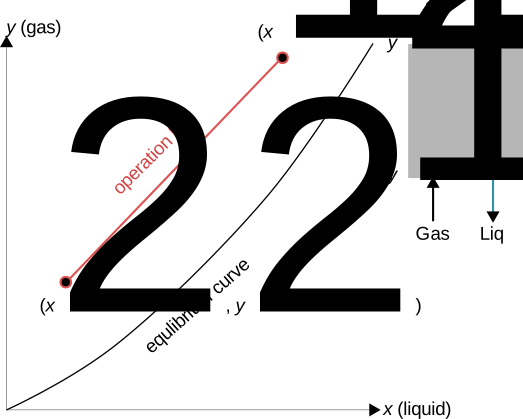
Absorption operating line in equilibrium diagram
Tip
- Mass balance tells us \(y_{A1} > y_{A2}\)
- A series of \((x, y)\) points during the operation forms the operating line
What questions do we want to study?
Given information about the absorption tower, can we answer?
- In- and out-let molar fractions ✅
- Required liquid / gas flow rate ✅
- Concentration profile → needs to know \(N_A\)
- Height of tower needed → needs to know \(N_A\)
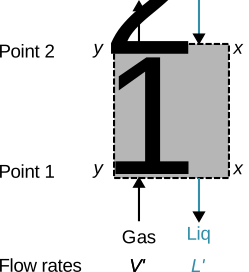
Mass balance in whole control volume
Mass balance for 2 phases:
\[\begin{align} \text{In}_{\text{liq}} + \text{In}_{\text{gas}} &= \text{Out}_{\text{liq}} + \text{Out}_{\text{gas}} \\ L_2 x_2 + V_1 y_1 &= L_1 x_1 + V_2 y_2 \end{align}\]- \(L_1 = L' + L_{x1}\) (\(L'\): flow rate inert liquid)
- \(V_1 = V' + V_{y1}\) (\(V'\): flow rate inert gas)
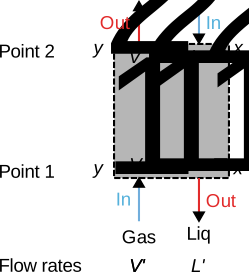
Explanation for flow rates
Note
Other flow rates: \(Q\) (m\(^3\)/s); \(W\) (kg/s); \(v\) (m/s)
- \(L\): molar flow rate (kg mol/s) for liquid phase
- \(L'\): flow rate for inert liquid
- \(L_{x1}\): flow rate for A at molar fraction \(x_1\)
- \(V\): molar flow rate (kg mol/s) for gas phase
- \(V'\): flow rate for inert gas
- \(V_{y1}\): flow rate for A at molar fraction \(y_1\)
Mass balance for operating line
The two ends of the operating line \((x_1, y_1)\) and \((x_2, y_2)\) follow:
\[\begin{align} L'\left(\frac{x_2}{1 - x_2}\right) + V'\left(\frac{y_1}{1 - y_1}\right) = L'\left(\frac{x_1}{1 - x_1}\right) + V'\left(\frac{y_2}{1 - y_2}\right) \end{align}\]Meaning of the operating line
When \(1 - x_1 \approx 1\) and \(1 - y_1 \approx 1\), we can rewrite the mass balance equation for any \((x, y)\) along the operating line
\[\begin{align}
y = \left(\frac{L'}{V'}\right) x +
\left[ y_1 -
\left(
\frac{L'}{V'}
\right)x_1
\right]
\end{align}\]
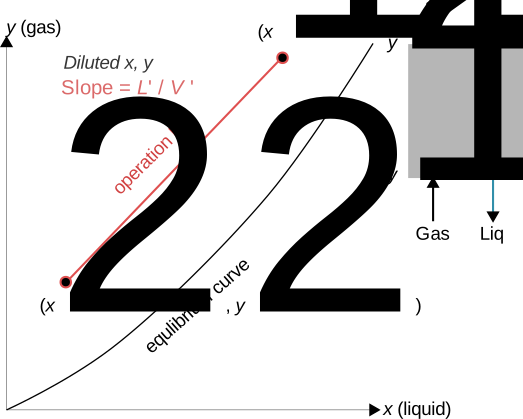
Absorption tower design requirements
In absorption tower, we usually know the following quantities:
- Gas inlet fraction \(y_1\) and flow rate \(V_1\)
- \(V'\) can be calculated
- Liquid inlet fraction \(x_2\) (usually \(x_2=0\))
- The equilibrium curve \(y=f_{\text{eq}}(x)\)
One of the following design goals may be asked:
- Know the flow rate \(L'\) → Determine \(y_2\)
- \(y_2\) needs to be at certain value → Determine \(L'\)
Minimum operating line for absorption tower
For question 2, we know the requirement for \(y_2\), combine with the equilibrium chart, there is a minimum liquid flow rate \(L'_{\text{min}}\).
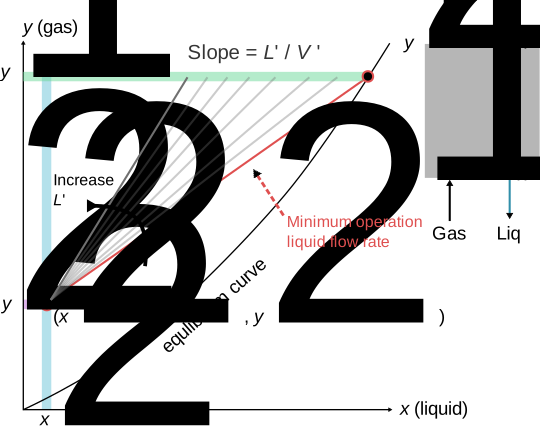
Flow rate in absorption tower
From the dilute regime operating line, the slope is determined by \(\left(\dfrac{L'}{V'}\right)\). Although there is a minimal \(\left(\dfrac{L'}{V'}\right)\) requirement, practical operating line has slope that follows
\[ \left(\dfrac{L'}{V'}\right) \approx 1.5 \times \text{[Slope of Eq. Curve]} \]
- If \(L'/V'\) is too high, the column usually needs a larger diameter to compensate the pressure drop.
- If \(L'/V'\) is too low, a taller absorption tower is needed for sufficient contact area.
Example 1: determine the outlet composition
A mixture of gas A in air kept at total pressure of 1 atm flows through an absorption tower with flowing water at 293 K. The inlet gas flow rate is \(V_1 = 100\) kg mol/h, and inlet \(y_1 = 0.20\). The liquid inlet flow rate is \(L' = 300\) kg mol/h and inlet contains no dissolved gas (\(x_2=0\)). At the outlets the gas-liquid phases reach equilibrium following the Henry’s law:
\[ y_2 = m x_1 \]
Calculate the outlet mole fraction \(y_2\) and \(x_1\) for the following cases:
- A is CO\(_2\), \(m = 1.42\times 10^3\)
- A is SO\(_2\), \(m \approx 10\)
Example 2: solution process
- Write the mass balance equation
Obtain \(L'\) and \(V'\)
\(x_1\) and \(y_2\) relation from Henry’s law
Example 2: results
Warning
\(y_1\) and \(y_2\) are supposedly large, so \(1 - y_1 \approx 1\) is not correct!
Example 2: quanlitative analysis
- Slope of operating line \(L'/V'\)
- Slope of equilibrium curve \(m\)
- CO\(_2\): \(m \gg L'/V'\), can be treated as if gas phase concentration is fixed!
- SO\(_2\): measurable decrease of SO\(_2\) fraction in outlet gas
Summary
- Reading equilibrium chart and operating line
- Mass balance equation for 2 phases
- Solving the flow rate – concentration relation