CHE 318 Lecture 31
Cooling Tower Design (II)
- Slides 👉 Open presentation🗒️
- PDF version of course note 👉 Open in pdf
- Handwritten notes 👉 Open in pdf
Learning outcomes
After this lecture, you will be able to:
- Recall the operating-line framework on the cooling-tower enthalpy-temperature chart.
- Identify the minimum gas flow rate using the tangent condition.
- Describe interfacial heat- and mass-transfer balances for cooling towers.
- Analyze the roles of sensible and latent heat in the gas-side energy balance.
Cheatsheet for cooling tower
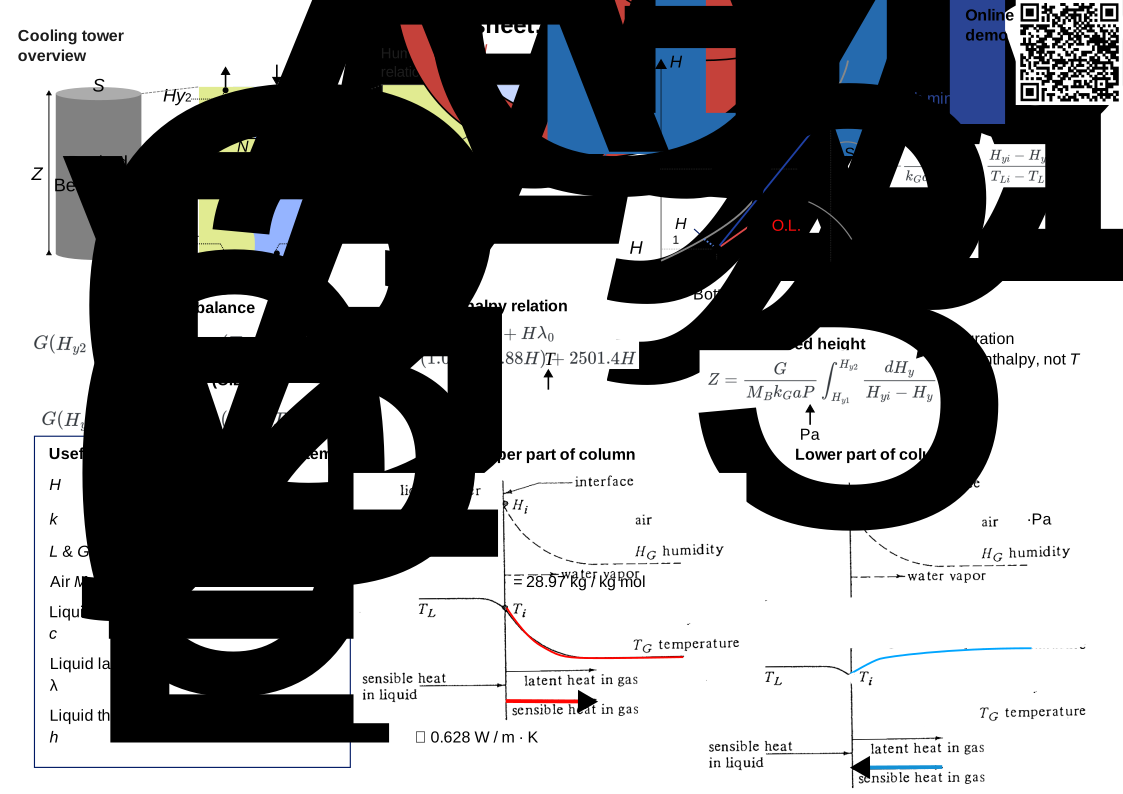
Recap: what do we solve for cooling tower?
For cooling tower, what are easy and hard to solve?
Easy (profile doesn’t change shape)
- Gas phase humidity \(H\)
- Liquid phase temperature \(T_L\)
Hard (profile changes shape)
- Gas temperature \(T_G\)
Recap: the enthalpy - temperature chart
For cooling system, we prefer to use Gas Enthalpy \(H_y\) and Liquid Temperature \(T_L\) in a chart.
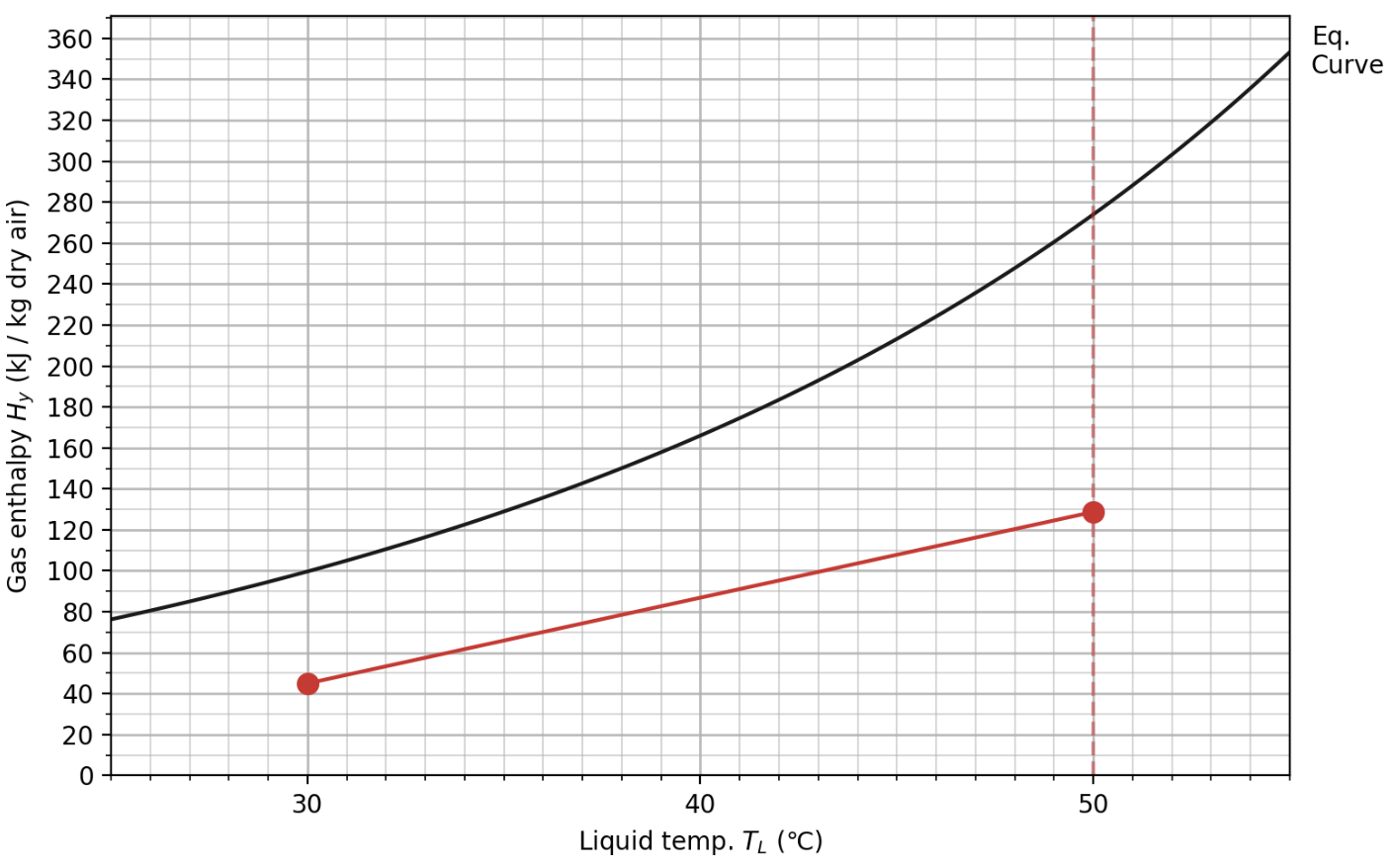
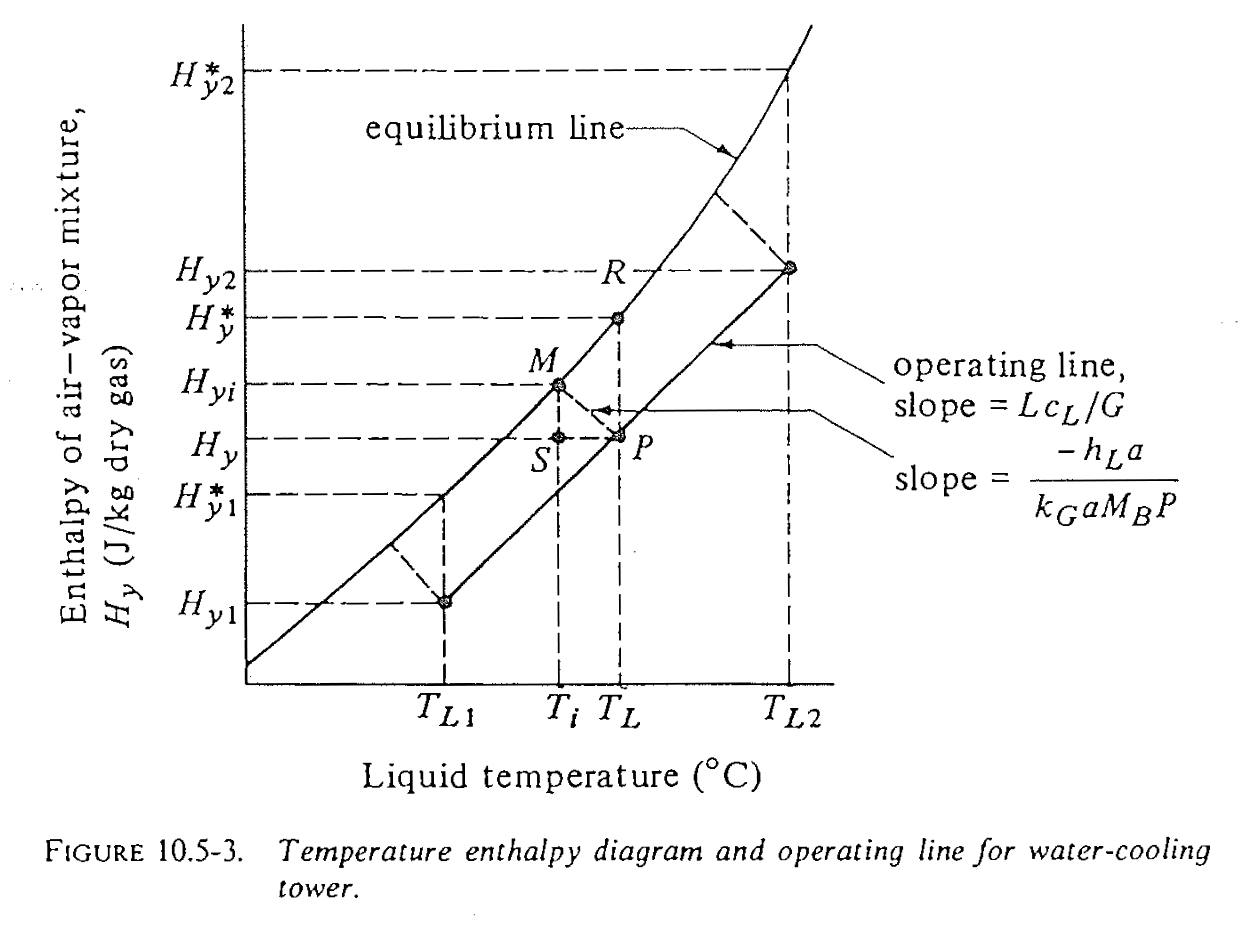
Recap: what is the operating line?
Recall in the case of absorption packed-bed tower, we solved a mass balance equation to describe operating line in the \(x-y\) diagram. The same applies to the cooling tower. An energy balance is used
\[\begin{align} \text{Energy}_{\text{In}} &= \text{Energy}_{\text{Out}} \\ G (H_{y2} - H_{y1}) &= L c_L (T_{L2} - T_{L1}) \end{align}\]Meaning of the mass balance & operating line
The operating line in cooling tower is just a linear line with expression
\[ G (H_y - H_{y1}) = L \cdot c_L (T_L - T_{L1}) \]
and a slope of \(\frac{L \cdot c_L}{G}\). (\(c_L \approx 4.18\) kJ / kg · K)
Question 3: what is the minimal flow rate?
Similar to absorption tower, but since we’re below the equilibrium line 👉 use tangent construction to find \(G_{\text{min}}\)
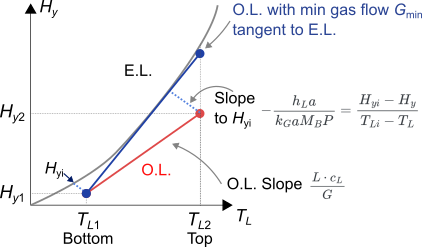
Minimal flow rate demo
Also see assignment 8
Question 4: solving interfacial profile
Like absorption tower, we’re again interested in solving the interfacial profile, in order to finally find the height of the tower. How did we achieve that in absorption tower?
Use a control volume from \(z\) to \(dz\), the mass balance for that region is
\[\begin{align} \text{Energy}_{\text{In}} &= \text{Energy}_{\text{Out}} \\ G dH_{y} &= L c_L dT_L \end{align}\]- L.H.S. contains \(d H_y\): contribution from both sensible & latent heat
- R.H.S. contains \(d T_L\): only sensible heat
Heat transfer at interfaces (1)
To rewrite the R.H.S \(L c_L dT_L\), we can use the liquid heat transfer coefficient \(h_L a\)
\[\begin{align} L c_L dT_L &= h_L a (T_L - T_{Li}) dz \end{align}\]- Sensible heat flux in liquid \(q_{L,S}\): from liquid to gas
- \(h_L a\) depends on the actual packing geometry!
Heat transfer at interfaces (2)
The L.H.S. \(G dH_{y}\) requires some attention, since such heat flux requires both sensible and latent heat fluxes \(q_{G,S}\) and \(q_{G,\lambda}\), respectively
\[\begin{align} G dH_y &= q_{G,S} + q_{G,\lambda} \\ &= h_G a dz (T_i - T_G) + \lambda_0 a N_A M_A \end{align}\]The results can be further simplified, which will be covered in Lecture 32.
Summary
- The operating line for a cooling tower comes directly from the overall energy balance.
- Minimum gas flow is identified by a tangent construction on the enthalpy-temperature chart.
- Interfacial balances separate the liquid sensible-heat term from the gas sensible-plus-latent contribution.