CHE 318 Lecture 19
Case Studies With Mass Transfer Coefficient
- Slides 👉 Open presentation🗒️
- PDF version of course note 👉 Open in pdf
- Handwritten notes 👉 Open in pdf
Learning outcomes
After this lecture, you will be able to:
- Recall the steps for convective mass transfer calculations using coefficient correlations and dimensionless numbers.
- Apply equations to calculate \(k_c'\), outlet concentration, and flux for internal-flow problems.
- Describe how geometry and flow regime influence pipe mass transfer.
General procedure to calculate \(k_c'\)
- Dimensionless numbers solely from geometry and property: \(N_{Re}\), \(N_{Sc}\)
- Dimensionless number having \(k_c'\): \(N_{Sh}\)
- Link between them: \(j_D\)
- How to obtain \(j_D\)?
- Expression for different geometry / fluid flow
- Use Table / Chart
Cheatsheet for mass transfer coefficient
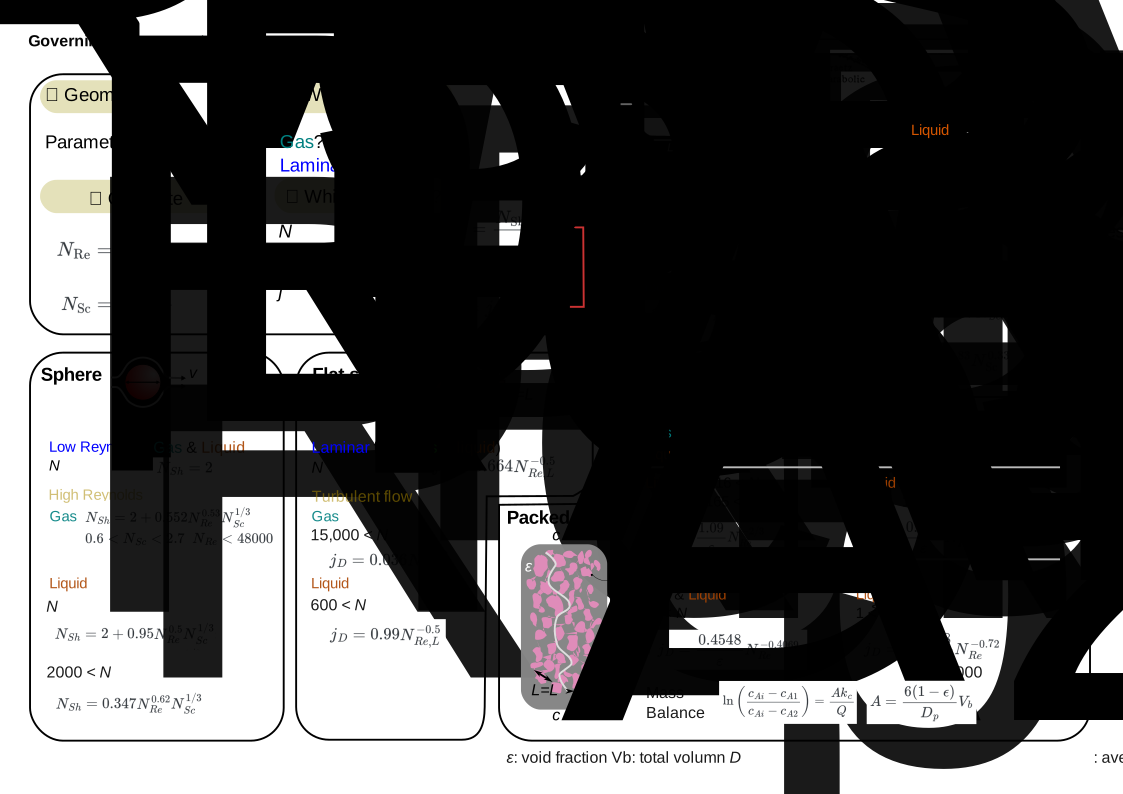
Example 1: mass transfer for flow inside pipes
Problem 7.3.1: A tube is coated on the inside with naphthalene and has inside diameter of 20 mm & a total length of 1.10 m. Air at 318 K and average pressure of 101.3 kPa flows through the pipe with velocity of 0.8 m/s. Calculate the concentration of naphthalene at outlet
Physical properties: \(D_{AB} = 6.92\times 10^{-6}\ \text{m}^2/\text{s}\), vapour pressure \(p_{Ai}=74.0\ \text{Pa}\). For air, \(\mu = 1.932\times 10^{-5}\ \text{Pa}\cdot \text{s}\), \(\rho=1.114\ \text{kg}/\text{m}^3\)
Flow inside pipe: chart
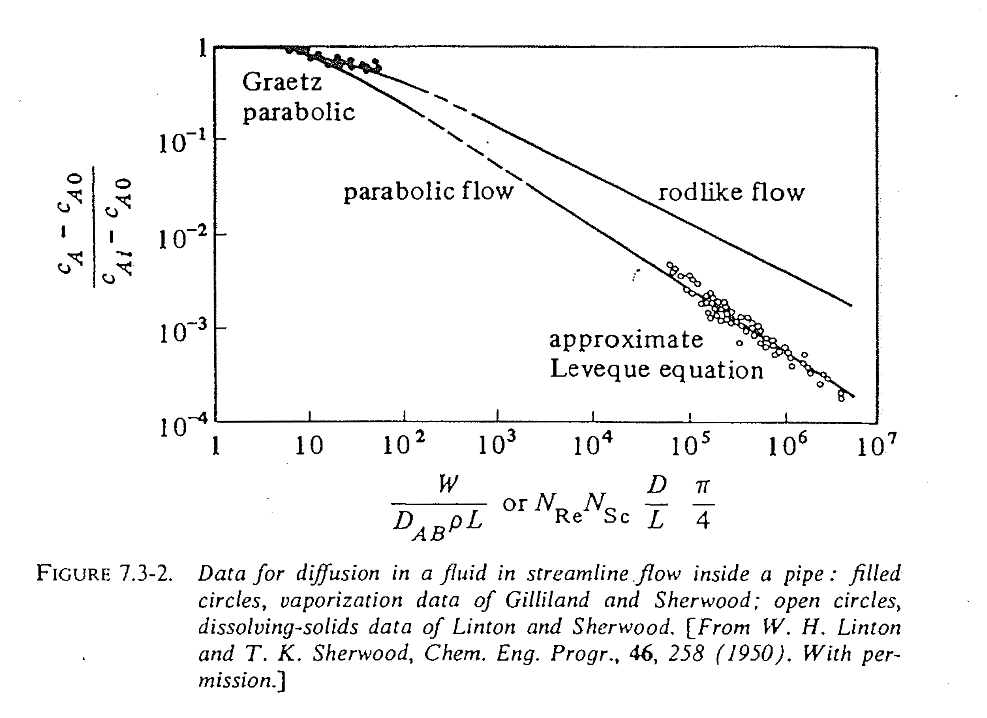
Flow inside pipes: solution procedure
- Governing dimensionless quantity:
- If gas 👉 use the “rodlike flow” line
- If liquid, distinguish 2 cases
- parabolic flow (\(N_{Re} < 2100;\ \frac{W}{D_{AB}\rho L} > 400\))
- turbulent flow (\(N_{Re} > 2100;\ 0.6 < N_{Sc} < 3000\))
Flow inside pipes: solution for liquid
Parabolic flow
\[\begin{align} \frac{c_A - c_{A,0}}{c_{A,i} - c_{A,0}} &= 5.5 \left[ \frac{W}{D_{AB}\,\rho\,L} \right]^{-\tfrac{2}{3}} \end{align}\]\(c_A\): exit concentration
\(c_{A,i}, c_{A,0}\): interface & inlet concentration
\(W\): flow rate in (kg/s)
\(k_c'\) can be calculated by \(j_D\)
Turbulent flow
\[\begin{align} N_{Sh} &= k_c'\left(\frac{D}{D_{AB}}\right) \\ &= \frac{k_c\,p_{BM}}{P} \left(\frac{D}{D_{AB}}\right) \\ &= 0.023 \left(\frac{\rho D v}{\mu}\right)^{0.83} \left(\frac{\mu}{\rho D_{AB}}\right)^{0.33} \\ &= 0.023\, N_{Re}^{0.83}\, N_{Sc}^{0.33} \end{align}\]- Similar to the \(j_D\) analog
- Just need \(N_{Re}\) and \(N_{Sc}\) to determine \(k_c'\)
- Characteristic length \(D\) is pipe diameter!
Review example 1: solution steps
Problem 7.3.1: A tube is coated on the inside with naphthalene and has inside diameter of 20 mm & a total length of 1.10 m. Air at 318 K and average pressure of 101.3 kPa flows through the pipe with velocity of 0.8 m/s. Calculate the concentration of naphthalene at outlet
Physical properties: \(D_{AB} = 6.92\times 10^{-6}\ \text{m}^2/\text{s}\), vapour pressure \(p_{Ai}=74.0\ \text{Pa}\). For air, \(\mu = 1.932\times 10^{-5}\ \text{Pa}\cdot \text{s}\), \(\rho=1.114\ \text{kg}/\text{m}^3\)
- Step 1: Calculate \(N_{Re}\), \(N_{Sc}\). Which regime?
Review example 1: solution steps
- Step 2: find normalized concentration on chart
Example 1: follow up
How will the outlet concentration change, if we double the gas velocity (i.e. \(v_m = 1.6\) m/s)?
If gas-phase \(D_{AB}\) becomes smaller, how will the outlet concentration change?
Example 1-2: pipe mass transfer in liquid
Problem 7.3-2: Pure water at 26.1°C (\(ρ = 996\ \text{kg}/\text{m}^3\), \(\mu = 8.71\times 10^{-4}\) Pa·s) flows at an average velocity of 0.0305 m/s through a tube of inside diameter 6.35 mm. The tube is 1.829 m long, and the last 1.22 m of the tube wall is coated with benzoic acid.
The solubility of benzoic acid in water is 0.02948 kg mol/m\(^3\), and the diffusivity of benzoic acid in water is \(1.245 \times 10^{-9}\) m\(^2\)/s. For water, \(\mu=8.71\times 10^-4\) Pa\(\cdot\)s and \(\rho=996\) kg/m\(^3\). Calculate the cross-sectional average concentration of benzoic acid at the outlet.
Example 1-2: solution steps
- Step 1: calculate \(N_{Re}\), \(N_{Sc}\). Regime?
- Step 2: check the value \(W/D_{AB} \rho L\). Able to use liquid formula?
- Step 3: insert into equations
Parabolic flow
\[\begin{align} \frac{c_A - c_{A,s}}{c_{A,i} - c_{A,s}} &= 5.5 \left[ \frac{W}{D_{AB}\,\rho\,L} \right]^{-\tfrac{2}{3}} \end{align}\]Turbulent flow
\[\begin{align} N_{Sh} &= k_c'\left(\frac{D}{D_{AB}}\right) \\ &= \frac{k_c\,p_{BM}}{P} \left(\frac{D}{D_{AB}}\right) \\ &= 0.023 \left(\frac{\rho D v}{\mu}\right)^{0.83} \left(\frac{\mu}{\rho D_{AB}}\right)^{0.33} \\ &= 0.023\, N_{Re}^{0.83}\, N_{Sc}^{0.33} \end{align}\]Example 1-2: results
- Use \(L_D=6.35\) mm for \(N_{\text{Re}}\)
- Please use \(L=1.22\) m for \(N_{\text{Sh}}\)!
The following numbers were obtained
- \(N_{\text{Re}}=221.4\)
- \(N_{\text{Sc}}=702.41\)
- \(W=9.616\times 10^{-4}\) kg / s
- x-axis: 634.4
- Use the liquid laminar equation to get \(c_{A,\text{out}}=2.196\times 10^{-3}\) kg mol/m\(^3\)
Summary
- Learn to use the coefficient chart to solve for different systems
- Case study of transport in a tube geometry